AI-powered multichannel outreach is reshaping how businesses connect with prospects. By using multiple platforms - like email, LinkedIn, SMS, and phone calls - this approach increases engagement and conversion rates. Adding AI to the mix automates repetitive tasks, personalizes messages at scale, and optimizes timing based on real-time data.
Here’s what you need to know:
With the right setup - clean data, email infrastructure, and AI tools - you can scale outreach safely and effectively. The key? Focus on personalized, well-timed interactions across multiple channels.
When running AI-driven outreach campaigns, setting up a solid email infrastructure is a must. One of the first steps is separating your cold outreach emails from your primary corporate domain. Think of your main domain (e.g., brand.com) as the hub for internal communication, customer support, and existing client relationships. Meanwhile, cold outreach should be handled through dedicated subdomains like outreach.brand.com or alternative domains such as trybrand.com. This separation ensures that any potential reputation issues from outreach campaigns won’t spill over into your core business email.
For B2B teams in the U.S. targeting large prospect lists every month, a scalable strategy involves using 10–20 outreach domains, each hosting 3–5 mailboxes. This setup creates 30–100 low-volume sending accounts, with each mailbox sending 30–50 emails daily. This approach keeps email volumes low enough to avoid spam filters while maintaining the capacity to scale outreach efforts. To reduce the risk of emails being flagged as spam, make sure all domains are authenticated with properly aligned SPF, DKIM, and DMARC records.
Managing this setup manually can quickly become overwhelming. Configuring DNS records, SSL certificates, and domain masking for dozens - or even hundreds - of domains can take up significant IT resources. Tools like Mailforge simplify this process by automating the creation and configuration of domains and mailboxes. With features like automated DNS setup and bulk updates, Mailforge allows teams to handle these tasks in minutes instead of hours.
Danny Goff, Director of Sales at
, shared, “Procedures that usually took hours (setting DKIM, SPF, etc. records) for multiple domains now take a few minutes.”
Once your domains are ready, the next step is to focus on email deliverability.
New email accounts require a gradual warm-up period - typically 2–4 weeks - to avoid triggering spam filters. During this time, each mailbox should slowly ramp up its daily email volume while generating authentic engagement signals like opens, replies, and forwards. These actions help build trust with mailbox providers.
Maintaining list hygiene is just as important. Bounce rates above 2–3% or spam complaint rates exceeding 0.1–0.2% can lead to automatic throttling by email providers. AI systems should monitor these metrics in real time and take immediate action when issues arise. For instance, problematic mailboxes can be paused, backup domains activated, or outreach shifted to platforms like LinkedIn if email performance starts to decline. Tools like Warmforge automate this process by tracking key metrics such as inbox reputation, spam folder placement, and engagement signals. The tool alerts teams to performance dips, enabling AI systems to adjust routing before deliverability takes a hit.
Ongoing engagement management is essential as well. Contacts who consistently ignore or never open emails should be removed from sequences to maintain healthy engagement rates. AI-driven orchestration tools can dynamically throttle email sends, rotate domains, or tweak content based on real-time feedback from warm-up and monitoring systems.
Once your email infrastructure and deliverability are in place, the next focus should be on data quality. AI personalization and channel selection rely entirely on having accurate, up-to-date data. Invalid email addresses increase bounce rates and damage domain reputation, while missing firmographic details - like industry, company size, or revenue - limits the AI’s ability to segment audiences effectively. Outdated contact roles can lead to irrelevant messaging, which often results in spam complaints. For U.S.-based leads, it’s especially important to include accurate time zones, normalized state and ZIP code formats, and CAN-SPAM compliance details like a physical address and opt-out options.
A strong data pipeline involves several key steps:
Tools like Leadsforge streamline this process by validating emails, enriching contact profiles, and outputting segmented lists ready for AI campaigns. By enforcing strict rules - such as only allowing verified emails with complete role and company data - you can ensure that low-quality contacts never make it into your outreach sequences. This protects your domain reputation and enhances the effectiveness of personalization efforts.
Teams should also define a clear ICP schema that includes firmographic fields (e.g., industry, employee count, ARR range), technographic fields (e.g., tools used), and persona details (e.g., department, seniority, job title keywords). Segmenting your audience into tiers - such as Tier 1 strategic accounts, Tier 2 core ICP, and Tier 3 experimental - along with behavioral categories like “opened in the past 30 days” or “clicked but no reply,” gives your AI the structure it needs to tailor campaigns. With this approach, your outreach can vary in message depth, frequency, channel mix, and offer type, avoiding the pitfalls of one-size-fits-all campaigns.
(function(d,u,ac){var s=d.createElement('script');s.type='text/javascript';s.src='https://a.omappapi.com/app/js/api.min.js';s.async=true;s.dataset.user=u;s.dataset.campaign=ac;d.getElementsByTagName('head')[0].appendChild(s);})(document,372145,'bgla6zdvtvvykvmfmifs');
Using high-quality, validated data is the backbone of effective audience segmentation. With accurate data driving AI-powered segmentation, you can create audience groups that receive the right message, through the right channel, at the perfect moment. Instead of reinventing your Ideal Customer Profile (ICP) every time, leverage clean data to build dynamic segments that adjust automatically as prospect behaviors evolve.
By integrating intent and behavior data, you can pinpoint active researchers versus less engaged prospects. For instance, intent signals might include topics they’ve been researching, tools they’ve compared, or review sites they’ve visited. Meanwhile, behavioral data captures actions like email opens, website visits, content downloads, or social media interactions. AI can analyze this multi-layered data using clustering techniques, uncovering specific micro-segments such as "Series B SaaS companies with 50–200 employees, evaluating outbound tools, and showing high website engagement." These insights allow AI to assign lead scores that reflect the likelihood of a meeting or deal closure. Prospects are then seamlessly moved between "cold", "nurture", or "high-intent" tracks based on their real-time actions, eliminating the need for manual updates.
A segmentation matrix can help organize this further by combining key factors such as persona (e.g., VP of Sales, RevOps, or Founder), account tier (Tier 1 strategic, Tier 2 mid-market, Tier 3 smaller accounts), and intent level (high, medium, or low). For example, Tier 1 accounts with high intent - like enterprise prospects who recently visited your pricing page - should receive more personalized attention and detailed multichannel strategies. On the other hand, Tier 3 accounts with low intent might be better suited for lighter, automated outreach. AI ensures these segments remain accurate by monitoring behavioral triggers and shifting contacts to the appropriate workflows. This alignment between sales and marketing ensures reps know when they need to step in and when AI can handle nurturing on its own.
These well-defined, dynamic segments lay the groundwork for customized multichannel outreach strategies.
Once your segments are in place, the next step is to design cadences that match the intent and preferences of each group. A successful multichannel cadence combines email, LinkedIn, calls, and SMS into a coordinated sequence. Research indicates that campaigns using three or more channels can achieve more than double the response rates of single-channel efforts.
AI plays a key role here by analyzing past campaign performance to recommend the best mix, order, and timing for outreach. It can even adjust cadences dynamically based on engagement signals. For instance, if a lead clicks a link in an email but doesn’t respond, AI might send a tailored follow-up instead of a generic reminder. If the lead doesn’t open the email at all, AI could test a call-first approach or pause outreach to protect sender reputation. Teams can also experiment with A/B testing - comparing short versus long cadences or email-heavy versus call-heavy approaches - and let AI optimize traffic toward the most effective strategies over time.
Platforms like Salesforge help execute these multichannel campaigns by automating sequences across email and LinkedIn, managing follow-ups, and fine-tuning timing and messaging based on engagement. For teams handling high-volume cold email campaigns, Mailforge manages the technical side - like warming up domains, rotating them to maintain IP health, and automating DNS setup - while Salesforge focuses on crafting and delivering AI-personalized cadences at scale. Together, these tools ensure campaigns are both technically sound and strategically effective.
Personalization is the heart of any successful campaign, and AI makes it scalable. By combining fixed elements - such as problem framing, positioning, and calls to action - with dynamic snippets, AI can craft messages that feel tailored to each recipient. These snippets pull from sources like LinkedIn profiles, company blogs, tech stack databases, or CRM notes. For example, an email intro might mention a recent product launch, funding news, or job posting that highlights a relevant pain point, while the body ties this to your solution and includes social proof.
To maintain a human touch, establish clear guidelines for AI-generated messages. For instance, emails might have a more formal tone, SMS messages should be concise, and LinkedIn messages can be conversational. While AI handles most of the heavy lifting, reps can review and tweak drafts for high-value accounts before sending. AI can also adapt a single core message to fit the nuances of each channel, ensuring consistency without sounding robotic.
Scaling personalization requires strict compliance with industry regulations. Teams must maintain accurate contact records, including opt-in/opt-out statuses and timestamps. Emails should include unsubscribe links and physical mailing addresses to meet CAN-SPAM requirements, while SMS and calls should respect TCPA rules, including local quiet hours and the need for prior express consent. Platforms like LinkedIn also have their own limits and policies, which should be built into your AI workflows to safeguard both deliverability and your brand’s reputation.
AI simplifies the juggling act of managing multiple outreach channels - email, LinkedIn, phone, SMS - by bringing everything under one roof. Think of it as a command center where data from your CRM, email platforms, and social media come together to coordinate every single touchpoint. For instance, if a prospect opens your email but doesn’t reply, AI can step in to send a LinkedIn connection request or even schedule a follow-up call with messaging that builds on the original email.
Tools like Salesforge make this process seamless by handling multichannel sequences and enabling AI-powered personalization across platforms like email and LinkedIn - all from one interface. Behind the scenes, platforms such as Mailforge provide the infrastructure to configure campaigns quickly and scale them effortlessly. This unified system ensures every channel complements the others, while your team stays in control through a single dashboard. Not only does this simplify campaign management, but it also allows AI to make smarter, real-time adjustments.
One of AI's superpowers is its ability to learn and adapt on the fly. For example, if a prospect clicks a link but doesn’t respond, AI might interpret this as lukewarm interest and shift the next interaction to a different channel with more tailored content. On the other hand, if emails are being ignored altogether, AI can pause email outreach to protect your sender reputation and test a call-first approach instead.
These real-time tweaks can lead to measurable boosts in engagement. However, the key is striking a balance: let AI handle routine optimizations while keeping high-value leads under manual review. This ensures your brand voice remains consistent and allows your team to address subtle nuances that automation might miss.
Once decision-making is fine-tuned, the next challenge is scaling your outreach without jeopardizing deliverability.
Scaling your campaigns without harming deliverability requires a thoughtful approach and the right tools. Start small - targeting 50 to 100 prospects in test campaigns - and keep a close eye on metrics like bounce rates, spam complaints, and engagement. From there, you can gradually ramp up, using the warm-up and monitoring techniques discussed earlier. AI can help by capping daily sends per domain, rotating mailboxes to spread the load, and adjusting volumes based on deliverability signals.
For larger-scale operations, having robust infrastructure is non-negotiable. Mailforge, for example, offers a shared yet affordable setup that’s trusted by over 10,000 businesses. If you’re looking for enterprise-level solutions, Infraforge provides private email infrastructure with multi-IP provisioning and API access, while Primeforge delivers Google Workspace and Microsoft 365 mailboxes hosted on US IPs - ideal for maintaining top-tier deliverability. These options let you send thousands of emails daily without risking your sender reputation.
Isabella L., Founder of Let's Fearlessly Grow, put it best: "Operating in a high-growth startup environment requires speed, scalability, and operational efficiency. We needed to build an outbound motion that didn't break as we scaled - and Mailforge gave us that foundation."
Tracking the right metrics is essential for understanding the performance of multichannel campaigns. Some key benchmarks include open rates (typically 20–40%), reply rates (which can reach up to 50% with AI-driven personalization), and meeting bookings (5–10%). Using three or more channels in a campaign can increase response rates by as much as 287%.
Breaking these metrics down by channel can reveal valuable insights. For example, email campaigns often see a 38% boost in open rates, while LinkedIn typically achieves 20–30% acceptance rates and 10–15% reply rates. A centralized dashboard can help visualize these metrics, making it easier to identify the most effective channel combinations for driving meetings and revenue. These insights provide a foundation for making real-time adjustments to improve overall performance.
Once you’ve established your key metrics, AI can take optimization to the next level. By analyzing trends, AI fine-tunes elements like timing, messaging, and channel mix. For instance, if email open rates drop below 20%, AI might shift focus to LinkedIn. Similarly, if prospects are clicking links but not responding, the system can test new messaging or adjust follow-up timing. These real-time tweaks have been shown to increase engagement by 26% and boost revenue by 40% for companies leveraging AI personalization.
AI also identifies the best times to engage prospects - say, Tuesdays at 10:00 AM EST - and schedules messages automatically. It refines call-to-action placements, replaces generic phrases with tailored language, and determines the most effective channel mix for each audience segment. In one example, a company improved its lead scoring accuracy by 40% through machine learning, allowing their team to focus on high-priority accounts while AI handled routine adjustments. With these data-driven optimizations, your team can work smarter, not harder, as you prepare to scale these improvements.
As your campaigns grow, automation becomes indispensable. Tools like Agent Frank can manage outreach cadences autonomously - pausing communications with non-responders, enriching prospect data, and realigning sequences in real time. This ensures a seamless scaling process while meeting the expectations of 71% of consumers, who prefer brands to engage with them through their preferred channels.
To maintain sustainable growth, regularly review your metrics, refine your strategies, and use tools like Agent Frank to handle cadence management. AI-driven segmentation based on behavior and demographics can increase engagement by approximately 30%. As your outreach expands, solutions like Salesforge provide unlimited sender accounts and AI-powered personalization across multiple channels. Meanwhile, Mailforge ensures you can send thousands of messages daily without sacrificing deliverability. The goal isn’t just to send more - it’s to send smarter, ensuring every interaction counts.
AI-powered multichannel outreach works best when three essential components come together: a strong foundation, smart automation, and ongoing refinement. The foundation - things like domains, DNS records, mailbox warm-up, and clean prospect data - sets the stage for successful delivery. AI then steps in to coordinate timing, channels, and personalized interactions across multiple touchpoints. Finally, a feedback loop that tracks metrics like opens, replies, meetings, and revenue ensures the system keeps improving. If any of these pieces are missing, the entire effort can fall apart.
Using three or more channels in a campaign can boost response rates by up to 287%, and companies that excel in AI-driven personalization often achieve around 40% more revenue compared to others in their field. However, AI enhances a solid strategy - it won’t fix bad targeting. Common mistakes to avoid include over-automating without human oversight, scaling outreach before addressing deliverability issues, and ignoring compliance with regulations like CAN-SPAM and TCPA.
The key to multichannel outreach isn’t just sending more messages - it’s sending smarter ones. AI enables you to connect with the right people, on the right platforms, at the right time, all while maintaining a consistent and trustworthy brand voice. While your core value proposition should remain steady across channels like email, LinkedIn, and phone, the tone and format should adapt to fit each platform’s norms. Pay close attention to feedback - such as spam complaints, unsubscribe reasons, and responses - to fine-tune your approach and fix tone or messaging issues early.
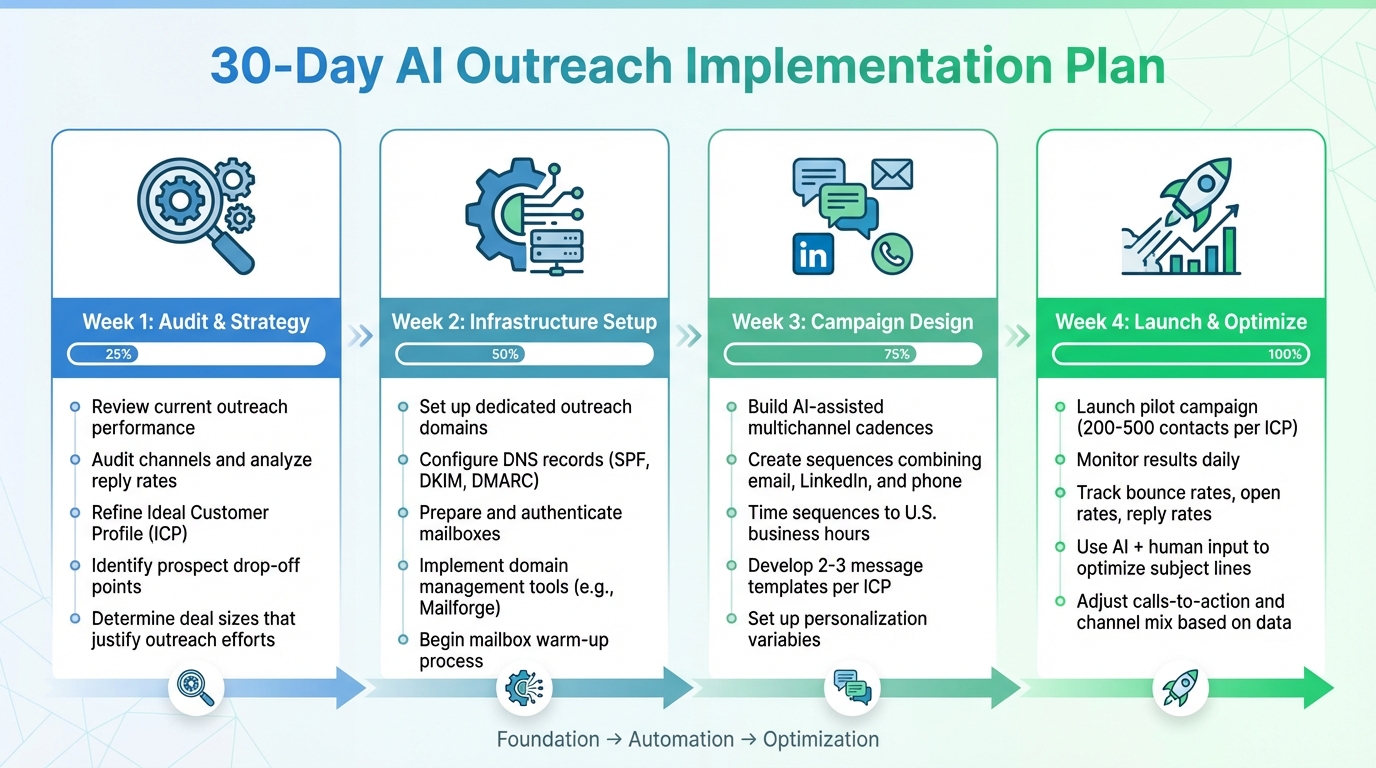
Armed with these insights, you can create a focused 30-day plan to kick off your AI-driven outreach. This method aligns with the broader goal of using AI to enhance every stage of your multichannel strategy.
To safely build your AI-powered multichannel outreach system, follow this 30-day action plan:
When selecting tools, ask yourself: Does this platform support the channels you rely on? Can it adjust timing based on engagement signals? Does it include features like deliverability monitoring, mailbox warm-up, and compliance with U.S. regulations? For high-volume cold email, specialized tools with automated DNS and domain masking are critical. For broader outreach, look for platforms that integrate data, channels, and reporting to give AI a unified view of each prospect. The ultimate goal isn’t just more outreach - it’s creating a system that evolves, adapts, and scales effectively, all while safeguarding your reputation and resources.
AI is revolutionizing multichannel outreach by making it more targeted, manageable, and effective. It takes care of repetitive tasks like handling message sequences, fine-tuning send times, and evaluating performance metrics. This ensures your messages connect with the right people at the perfect moment.
Platforms like Mailforge simplify the process by offering reliable email infrastructure, excellent deliverability rates, and user-friendly setup. When combined with tools like Salesforge, businesses can effortlessly expand their outreach across platforms such as email and LinkedIn, all while keeping communication polished and tailored to their audience.
To make sure your AI-powered email outreach campaigns hit the mark, start by getting your email authentication right. Set up DMARC, SPF, and DKIM records correctly - and don’t forget to keep them updated. This not only boosts trust but also strengthens your email security. Adding a solid email infrastructure with tools like domain masking and SSL encryption can further improve your deliverability while safeguarding your domains.
Keep an eye on your deliverability metrics to catch any potential issues before they snowball. Tools like Warmforge can help you monitor performance and fine-tune your email placement. And here’s a pro tip: always work with a clean, verified contact list. This reduces bounce rates and helps you steer clear of spam complaints. By following these steps, you’ll set your campaigns up for success and see better results from your outreach efforts.
AI empowers businesses to break down their audiences into precise groups by analyzing massive amounts of data to uncover patterns like demographics, behaviors, and engagement trends. This means companies can create highly targeted audience segments, making their outreach more personal and relevant.
What’s more, AI takes the heavy lifting out of segmentation. By automating the process, it not only saves time but also boosts the effectiveness of campaigns. The result? Better response rates and deeper connections with potential customers. Using AI in your outreach strategy ensures your message hits the right people at just the right moment.
{"@context":"https://schema.org","@type":"FAQPage","mainEntity":[{"@type":"Question","name":"How can AI improve multichannel outreach strategies?","acceptedAnswer":{"@type":"Answer","text":"<p>AI is revolutionizing multichannel outreach by making it more <strong>targeted</strong>, <strong>manageable</strong>, and <strong>effective</strong>. It takes care of repetitive tasks like handling message sequences, fine-tuning send times, and evaluating performance metrics. This ensures your messages connect with the right people at the perfect moment.</p> <p>Platforms like Mailforge simplify the process by offering reliable email infrastructure, excellent deliverability rates, and user-friendly setup. When combined with tools like Salesforge, businesses can effortlessly expand their outreach across platforms such as email and LinkedIn, all while keeping communication polished and tailored to their audience.</p>"}},{"@type":"Question","name":"How can I improve email deliverability in AI-powered outreach campaigns?","acceptedAnswer":{"@type":"Answer","text":"<p>To make sure your AI-powered email outreach campaigns hit the mark, start by getting your email authentication right. Set up <strong>DMARC</strong>, <strong>SPF</strong>, and <strong>DKIM</strong> records correctly - and don’t forget to keep them updated. This not only boosts trust but also strengthens your email security. Adding a solid email infrastructure with tools like <strong>domain masking</strong> and <strong>SSL encryption</strong> can further improve your deliverability while safeguarding your domains.</p> <p>Keep an eye on your deliverability metrics to catch any potential issues before they snowball. Tools like <strong>Warmforge</strong> can help you monitor performance and fine-tune your email placement. And here’s a pro tip: always work with a clean, verified contact list. This reduces bounce rates and helps you steer clear of spam complaints. By following these steps, you’ll set your campaigns up for success and see better results from your outreach efforts.</p>"}},{"@type":"Question","name":"How can businesses use AI to segment their audiences more effectively?","acceptedAnswer":{"@type":"Answer","text":"<p>AI empowers businesses to break down their audiences into precise groups by analyzing massive amounts of data to uncover patterns like demographics, behaviors, and engagement trends. This means companies can create highly targeted audience segments, making their outreach more personal and relevant.</p> <p>What’s more, AI takes the heavy lifting out of segmentation. By automating the process, it not only saves time but also boosts the effectiveness of campaigns. The result? Better response rates and deeper connections with potential customers. Using AI in your outreach strategy ensures your message hits the right people at just the right moment.</p>"}}]}