Cold email compliance is all about following laws like CAN-SPAM (U.S.), GDPR (EU), and CASL (Canada) to avoid fines and build trust with your audience. Non-compliance can result in penalties reaching $53,088 per email under CAN-SPAM, €20 million under GDPR, or CAD $10 million under CASL. Here's what you need to know:
To stay compliant:
Using tools like Mailforge can simplify compliance by automating tasks like SPF, DKIM, and DMARC setup, improving deliverability, and ensuring adherence to regulations. Staying compliant not only avoids legal risks but also improves email engagement, with compliant campaigns seeing 38% higher open rates and 68% higher click-through rates.
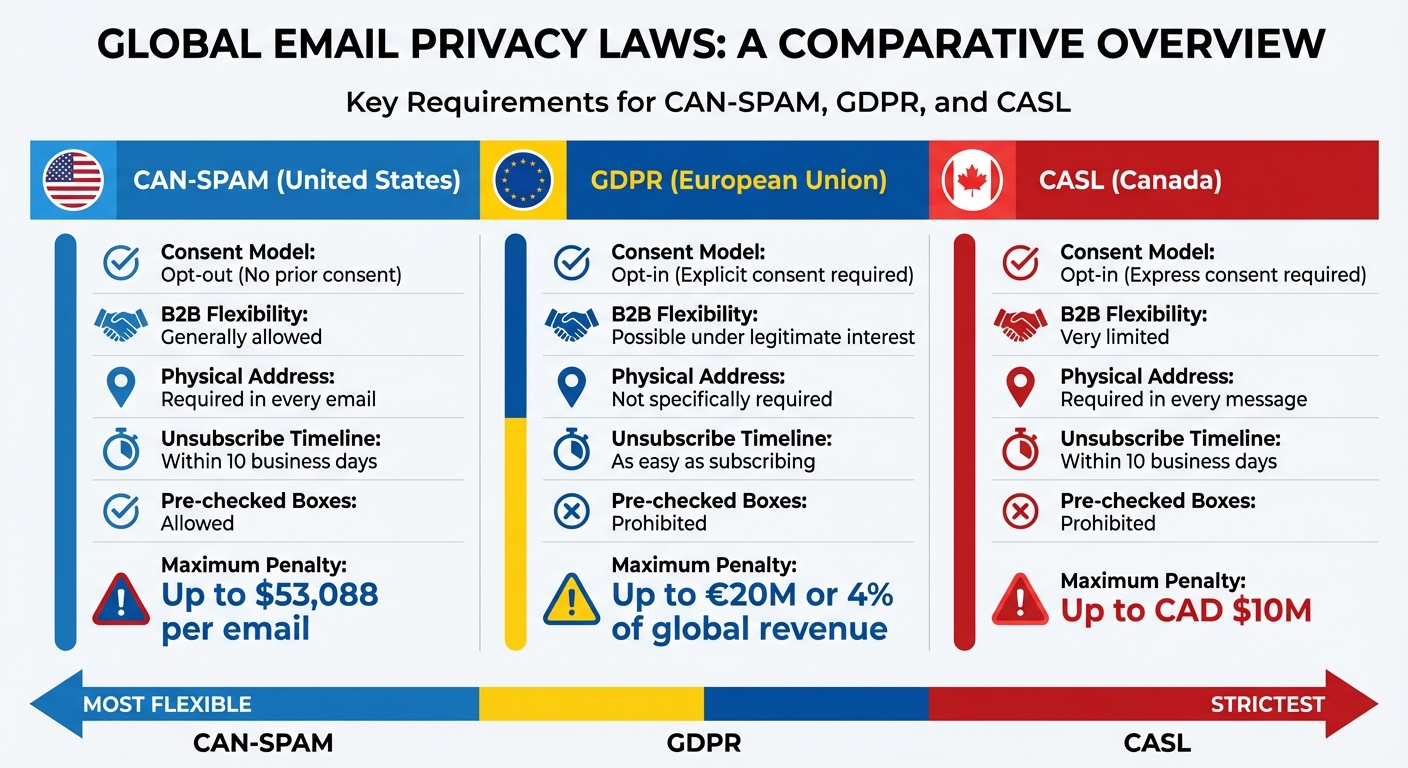
CAN-SPAM vs GDPR vs CASL: Cold Email Compliance Requirements Comparison
The CAN-SPAM Act follows an opt-out model, meaning you can send cold emails without prior consent, but you must adhere to specific rules. Each email must include accurate header information that clearly identifies the sender, including details like "From", "To", and "Reply-To." The subject line should accurately reflect the content of the message, and you must include a valid physical postal address - this can be a street address, P.O. box, or a registered private mailbox.
A clear unsubscribe option is non-negotiable. This should be a one-click mechanism that remains functional for at least 30 days. You must honor opt-out requests within 10 business days and cannot charge a fee or ask for additional information beyond the recipient’s email address to process the request. Starting February 2024, Google and Yahoo require bulk email senders to include one-click unsubscribe links in both the email body and header. Additionally, your spam complaint rate must stay below 0.3%.
If you’re using a third-party service to manage your email campaigns, remember that your business is still legally responsible for ensuring compliance. Violations can result in steep fines for each email that breaks the rules.
Next, let’s look at how GDPR handles consent differently.
The GDPR operates under an opt-in consent model, which is fundamentally different from the CAN-SPAM Act. For B2C outreach, you must obtain explicit permission before sending any marketing emails. For B2B communications, emails to corporate addresses may be allowed under the "legitimate interest" clause, provided the content is professionally relevant to the recipient’s role.
Unlike CAN-SPAM, GDPR does not require a physical address in every email. However, it does demand thorough documentation of consent, including the date, method, and source of permission. Non-compliance can lead to penalties of up to €20 million or 4% of global revenue, whichever is higher. With nearly half of individuals switching companies due to concerns about data privacy, GDPR compliance goes beyond avoiding fines - it’s about building trust.
If you rely on "legitimate interest" for B2B outreach, you’ll need to conduct a balancing test to ensure that your business needs don’t outweigh individuals’ privacy rights. To stay compliant, segment your contact lists by jurisdiction and apply GDPR standards where applicable - or consider using GDPR as a universal standard for all your campaigns.
Canada’s Anti-Spam Legislation (CASL) is the strictest of these regulations, requiring express consent before sending any commercial emails. Unlike the opt-out approach of CAN-SPAM, CASL prohibits pre-checked consent boxes entirely. You must have active, documented agreement from recipients before contacting them.
There are limited cases where implied consent applies, such as when someone has an ongoing business relationship with you or has attended a webinar you hosted. Similar to CAN-SPAM, every email must include the sender’s name, business name, contact details, a valid postal address, and an unsubscribe link that processes requests within 10 business days.
Violations can result in fines of up to CAD $10 million. With 68% of marketers reporting increased challenges in maintaining compliance as of 2024, implementing a double opt-in process can be a smart move. This method not only documents express consent but also provides extra protection during audits.
Below is a comparison of the key requirements for these three regulations:
| Requirement | CAN-SPAM (United States) | GDPR (European Union) | CASL (Canada) |
|---|---|---|---|
| Consent Model | Opt-out (no prior consent needed) | Opt-in (explicit consent required) | Opt-in (express consent required) |
| B2B Flexibility | Generally allowed | Possible under legitimate interest | Very limited |
| Physical Address | Required in every email | Not specifically required | Required in every message |
| Unsubscribe Timeline | Within 10 business days | Must be as easy as subscribing | Within 10 business days |
| Pre-checked Boxes | Allowed | Prohibited | Prohibited |
| Maximum Penalty | Up to $53,088 per email | Up to €20M or 4% of global revenue | Up to CAD $10M |
(function(d,u,ac){var s=d.createElement('script');s.type='text/javascript';s.src='https://a.omappapi.com/app/js/api.min.js';s.async=true;s.dataset.user=u;s.dataset.campaign=ac;d.getElementsByTagName('head')[0].appendChild(s);})(document,372145,'bgla6zdvtvvykvmfmifs');
Knowing the rules is one thing - putting them into action is another. The line between a compliant email campaign and a costly mistake often comes down to three essential practices: keeping your contact lists clean, offering clear unsubscribe options, and maintaining thorough documentation. Let’s dive into how to make these practices work for you.
A clean email list isn’t just good practice - it’s the foundation of compliance. Sending emails to invalid addresses, spam traps, or people who didn’t agree to hear from you can lead to legal trouble and poor performance. Permission-based campaigns, for example, have 38% higher open rates and 68% higher click-through rates compared to non-compliant lists. Clearly, clean data isn’t just about staying out of trouble - it’s also about better results.
Start by verifying every email address before you add it to your list. One company, for instance, slashed its email bounce rate from 12.3% to 2.1% in just 60 days by using cold email tools like a real-time Email Verification API. This boosted their deliverability by 34% and brought in $2.3 million in revenue.
If you’re sourcing data from third parties, ask for written proof that the data was collected legally. Also, document the legal basis for processing each contact’s information. Double opt-in lists, which require users to confirm their subscription, are another smart move. These lists not only comply with CASL regulations but also convert 22.7% better than single opt-in lists. Regularly clean your lists by removing bounced addresses, honoring opt-out requests immediately, and segmenting contacts by jurisdiction to meet the strictest legal standards, like GDPR.
Once your list is verified, the next step is to ensure recipients can easily opt out if they choose.
Your unsubscribe option needs to be easy to find, simple to use, and quick to process. This isn’t just a courtesy - it’s the law. A surprising 53% of users mark emails as spam when they can’t locate an unsubscribe link.
Starting February 2024, Google and Yahoo will require bulk email senders to include one-click unsubscribe links in both the email body and header. These links must be functional, and spam complaint rates need to stay below 0.3% to maintain good deliverability.
Before launching any campaign, test your unsubscribe links to make sure they work properly and lead to the correct landing page. Automate systems to flag replies with “unsubscribe” and sync opt-out requests across all your platforms to avoid accidental re-contact.
Under CAN-SPAM and CASL, you have 10 business days to process opt-out requests, while GDPR requires immediate action. Once someone opts out, their email must go on a suppression list to prevent future contact. You also can’t charge a fee, ask for additional personal details beyond the email address, or force users to visit more than one page to unsubscribe.
After cleaning your data and setting up reliable opt-out options, the final step is thorough documentation. Good record-keeping is a critical safeguard if you ever face an audit or complaint. Regulators will want to see how you collected each contact’s information and prove that you had permission to email them.
"In case of an audit or complaint, having a record of how you obtained a recipient's data and their consent (if applicable) is critical."
- Vicky Antonenkova, Author
Use a CRM system to log data sources, consent statuses, and communication history automatically. Record when and how you collected each email address, whether through a web form, a business card, or a public directory. For GDPR compliance, document your "lawful basis" for processing data, whether it’s explicit consent or a legitimate interest.
Keep detailed logs of opt-out requests, including timestamps and the method used, to create a solid audit trail. If you rely on legitimate interest for B2B outreach under GDPR, document your balancing test to show your business needs don’t outweigh an individual’s privacy rights.
Ignoring these steps can be costly. Violations can lead to fines of up to $53,088 per email under CAN-SPAM, €20 million or 4% of global revenue under GDPR, and CAD $10 million under CASL. Investing in proper documentation now can save you from financial headaches down the road.
Ensuring compliance with email regulations isn't just about understanding the rules - it's about having the right tools to make compliance part of your workflow. Manual DNS setups, missed authentication protocols, and scattered documentation can leave gaps that regulators notice. By using the right tools, you can integrate compliance into your outreach efforts seamlessly, creating a technical framework that supports the best practices discussed earlier.
Mailforge provides the essential technical infrastructure needed to meet privacy laws with ease. The platform automates the setup of SPF, DKIM, and DMARC across all your domains in just minutes. This automation eliminates the common errors that lead to issues like "DKIM Record Not Found" or "Invalid Record Format", which can flag your emails as non-compliant. These configurations are not only required under CAN-SPAM but also critical for avoiding spam filters and regulatory scrutiny.
The platform also includes SSL encryption and domain masking as standard features. SSL encryption protects data during transmission, while domain masking separates your primary business domain from cold email campaigns. This separation is a smart way to mitigate risk - if a campaign generates complaints, your main domain remains unaffected. Additionally, Mailforge supports bulk DNS updates, allowing you to quickly implement protocols across multiple domains.
Here's how Mailforge stacks up against traditional email providers like Google Workspace:
| Feature | Google Workspace | Mailforge |
|---|---|---|
| DKIM/SPF/DMARC Setup | Manual | Automated (1-Click) |
| Time to Set Up | 2–3 Hours | Under 5 Minutes |
| DNS Record Updates | Manual or Scripted | Automated |
| Cold Email Optimization | Medium | High (Built-in) |
| Price (200 mailboxes) | $1,200+ | ~$484 |
When you're managing dozens - or even hundreds - of domains, the time savings alone are invaluable. Beyond that, automating these processes minimizes human errors, which could otherwise lead to compliance vulnerabilities.
Mailforge lays the groundwork for compliance, but its full potential is unlocked when combined with other tools in the Forge Stack. Together, they ensure every aspect of your outreach complies with regulations, from email validation to consent tracking.
Salesforge brings precision to your campaigns by automatically validating email addresses, reducing bounce rates and avoiding spam traps. It also uses AI-driven personalization to make your emails more relevant while automating consent tracking and maintaining detailed audit trails. This is especially important for meeting GDPR requirements, such as demonstrating legitimate interest.
Warmforge works alongside Mailforge to monitor deliverability and build sender reputation gradually. By warming up domains and generating positive engagement signals, it helps ensure your emails land in inboxes rather than spam folders. This not only improves deliverability but also demonstrates the kind of recipient engagement that compliance auditors look for.
What makes the Forge Stack particularly effective is its seamless integration. Compliance data flows between tools automatically: opt-out requests processed in Salesforge sync with suppression lists across your entire system, and consent records captured during lead generation in Leadsforge are carried through to your sending platform. This centralized approach eliminates the risks associated with disconnected systems - risks that could lead to costly fines, which CAN-SPAM estimates at up to $53,088 per email.
Cold email compliance isn't optional - it’s a must. Violating regulations like CAN-SPAM can lead to fines of up to $53,088 per email, while GDPR penalties can climb to €20 million. On the flip side, compliant campaigns see 38% higher open rates and 68% higher click-through rates. Plus, using permission-based email lists reduces unsubscribes by 33%, keeping your audience engaged for longer.
Key steps to ensure compliance include regularly verifying email lists, offering one-click unsubscribe options in both the email body and header, and maintaining detailed records of consent. It’s also critical to automate DNS configurations for SPF, DKIM, and DMARC to meet authentication standards required by major providers like Google, Yahoo, and Microsoft. Starting May 5, 2025, Microsoft will reject emails from bulk senders that fail to meet these standards. Tools like Mailforge make these tasks simpler and more efficient.
Mailforge streamlines compliance by automating technical setups. What used to take hours can now be done in under five minutes. With built-in SSL encryption, domain masking, and bulk DNS updates, the platform minimizes manual errors that could lead to violations. Mailforge also integrates seamlessly with tools like Salesforge, Warmforge, and Leadsforge, creating a centralized system for compliance. Consent tracking in Salesforge, sender reputation management in Warmforge, and verified lead lists from Leadsforge all sync effortlessly, ensuring compliance across every stage of your outreach.
Beyond just avoiding fines, compliance enhances performance. By embedding compliance into your workflow, you not only reduce legal risks but also build trust with your audience. With the right tools in place, staying compliant becomes a natural part of your process rather than an added burden.
When sending cold emails, understanding the legal requirements is crucial, especially since the rules vary depending on where your recipients are located. Here’s a breakdown of the three major laws you need to keep in mind:
CAN-SPAM governs emails sent to or from the United States. It permits sending emails without prior consent, as long as you provide a clear way for recipients to opt out.
GDPR, which applies across the European Union, takes a stricter approach. You must obtain explicit consent before reaching out and adhere to rigorous data protection standards.
CASL, in Canada, also requires prior consent but enforces even tighter restrictions on electronic communication.
Despite their differences, all three laws share some common requirements. You must include accurate sender details, a physical mailing address, and subject lines that aren’t misleading.
The penalties for non-compliance, however, can be steep and vary widely:
To steer clear of legal trouble, it’s essential to tailor your email practices to meet these regulations.
To keep your cold email campaigns on the right side of international laws, focus on personalization, transparency, and consent. Start by personalizing your emails - use the recipient's name, their role, or even reference a recent activity of theirs. Be upfront about who you are and why you're reaching out. Don't forget to include an opt-out link and a physical mailing address, as these are required by regulations like the U.S. CAN-SPAM Act, GDPR, CASL, and CCPA. If you're targeting regions like the EU or Canada, make sure to get explicit consent before sending emails or handling personal data, and keep a record of this consent for future reference.
It’s also crucial to maintain the technical integrity of your campaigns. Implement SPF, DKIM, and DMARC authentication to build trust and protect your sender reputation. Tools like Mailforge, Infraforge, or Primeforge can help automate these processes and make compliance easier. On top of that, regularly review your data sources, update your privacy policies, and ensure your team is trained on the latest regulations. By pairing compliant messaging with robust technical safeguards, you can run successful campaigns while steering clear of legal troubles.
Staying on top of cold email regulations like CAN-SPAM, GDPR, and CCPA doesn’t have to be a headache when you use the Forge-stack tools. For instance, Mailforge takes care of the essentials by automatically including sender details, unsubscribe links, and compliant subject lines. It also handles email authentication with built-in management for SPF, DKIM, and DMARC settings.
If you’re looking to step up your outreach game, Salesforge lets you create multi-channel sequences (combining email and LinkedIn) while ensuring compliance fields are seamlessly added to every message. On top of that, Agent Frank, an AI-powered assistant, drafts email copy that complies with regulations, tracks opt-out requests, and keeps your scripts legally up to date. These tools make it easier to focus on growing your campaigns without worrying about breaking any rules.