
GDPR compliance in 2026 is stricter than ever, with regulators leveraging AI tools to enforce rules and businesses facing higher scrutiny. Here's what you need to know to stay compliant and improve your email outreach:
To avoid penalties and maintain trust, businesses must focus on consent documentation, secure email systems, and transparent practices. Compliance isn't just about avoiding fines - it's about creating better connections with your audience.
Starting in 2025, explicit consent becomes a must-have for cold email outreach, even in the B2B space. This marks a shift from the once-common reliance on "legitimate interest" as a justification. Regulators are now taking a much closer look at how companies collect, enrich, and use email data - especially when AI tools are part of the equation. This change highlights the growing focus on how AI integrates into data practices.
One area drawing particular attention is AI-enriched data. If your tools gather intent signals or private information without explicit consent, you could face compliance challenges. Additionally, regulators are examining algorithmic transparency, aiming to ensure AI systems used for targeting and personalization align with data minimization principles.
These new mandates have a direct impact on B2B outreach strategies. The days of relying on "legitimate interest" exemptions are over. By 2026, EU regulators are steering businesses toward an opt-in model, even for professional communications. Meanwhile, U.S. states like Virginia, Colorado, and California are adopting frameworks similar to GDPR, emphasizing explicit consent over implied permission.
"GDPR mandates clear transparency, personalisation, and a straightforward opt-out option in cold emailing to enhance compliance and build trust with recipients."
– Ana Mishova, GDPR Local
This shift has practical implications. Purchased lists, scraped data, and third-party databases are off the table unless you can prove that every contact has explicitly agreed to receive communications from your company.
By 2026, the double opt-in process becomes the benchmark for obtaining consent. With this method, contacts confirm their subscription through a verification email, creating a reliable audit trail. Not only does this approach ensure compliance, but it also delivers results - double opt-in lists see 22.7% higher conversion rates compared to single opt-in lists.
When requesting consent, clarity is key. Clearly outline the types of emails recipients can expect, how often they’ll receive them, and how their data will be used for personalization.
Documentation is just as important. Record every instance of consent with details like the opt-in text, IP address, timestamp, and confirmation action. If AI tools are part of your personalization strategy, audit them regularly to ensure they don’t pull private or sensitive data that could breach data minimization principles. This documentation should be easy to access and export in case of a regulatory review.
"Consent is not a hurdle; it's an opportunity. It allows us to engage with an audience that's genuinely interested in what we have to offer."
– Zoe Aughinbaugh, Email Marketing Expert
For businesses looking to scale their outreach, compliance features need to be baked into your infrastructure. Automated consent tracking, geographic segmentation to meet local regulations, and real-time content review are no longer optional - they’re essential for running a compliant cold email operation.
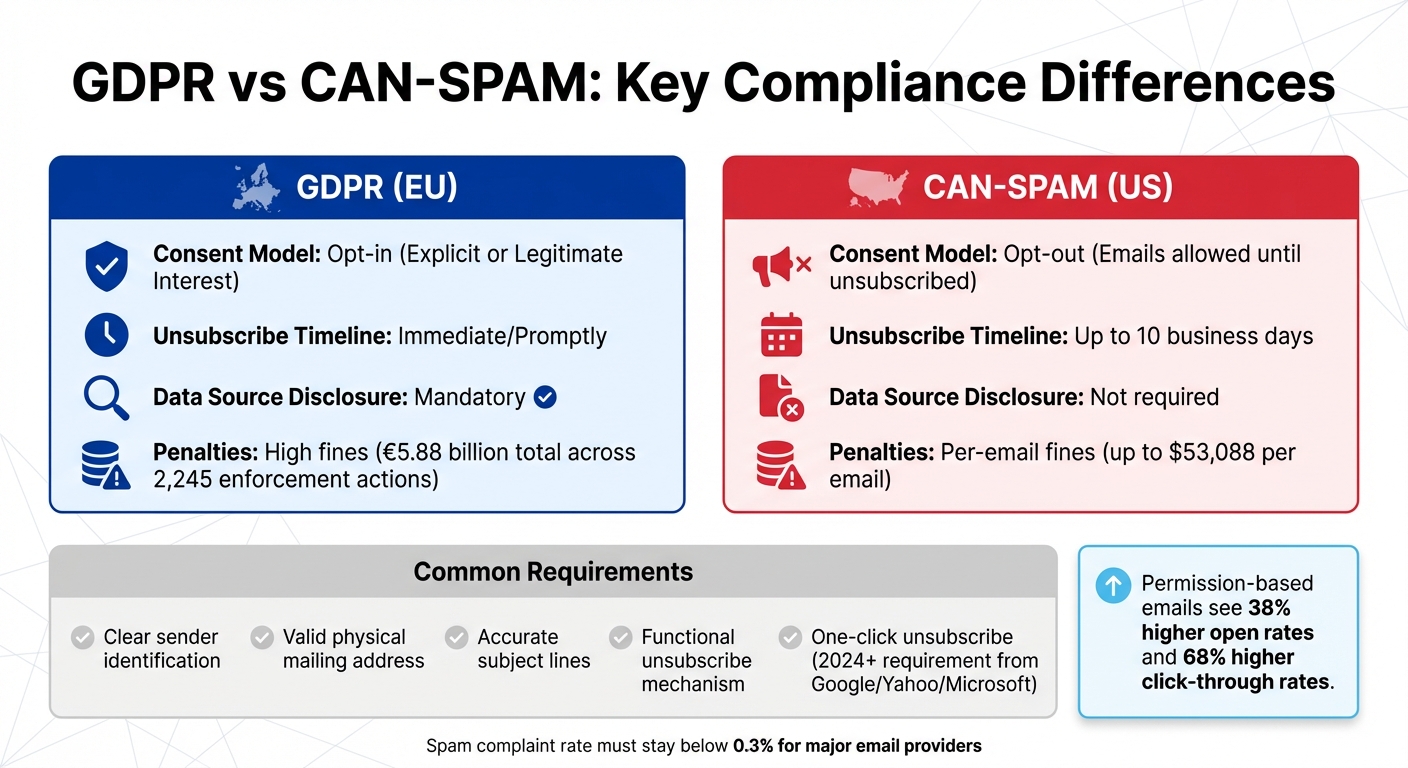
GDPR vs CAN-SPAM Email Compliance Requirements Comparison 2025
Transparency isn’t just a best practice - it’s a legal requirement, and failing to comply can cost businesses heavily. In 2026, enforcement agencies are cracking down on companies that don’t clearly identify themselves or provide easy ways for recipients to opt out of communications. For example, in December 2024, the French regulator CNIL fined Orange €50 million for sending advertisements that blended in with regular emails, all without obtaining proper consent. On top of that, Orange faced daily fines for non-compliance. Carrefour Group also faced penalties of €3.05 million after customers complained that the company ignored their rights, including the right to object to marketing.
Common mistakes like vague sender details or broken unsubscribe links can lead to steep fines. Under the CAN-SPAM Act, penalties can reach up to $50,120 for each offending email. Meanwhile, GDPR-related fines have totaled around €5.88 billion across 2,245 enforcement actions as of early 2025. The message is clear: every email must include transparent and verifiable elements to avoid these costly mistakes.
Every cold email you send must check a few essential boxes to meet transparency standards. First, clearly identify yourself. Use your company name instead of a personal name or a generic alias. Include a valid physical mailing address where your business operates, and make sure your subject line accurately reflects the email’s content - misleading headers are an easy way to land in hot water.
Another key requirement is disclosing how you obtained the recipient’s email address. Whether you found it on a company’s "About Us" page, a public LinkedIn profile, or through a data provider, this information must be stated clearly. This is mandatory under GDPR, though not required under CAN-SPAM.
| Requirement | GDPR (EU) | CAN-SPAM (US) |
|---|---|---|
| Consent Model | Opt-in (Explicit or Legitimate Interest) | Opt-out (Emails allowed until unsubscribed) |
| Unsubscribe Timeline | Immediate/Promptly | Up to 10 business days |
| Data Source Disclosure | Mandatory | Not required |
| Penalties | High fines | Per-email fines |
Adding a brief statement about data subject rights can also go a long way. A simple postscript explaining how recipients can request their information to be removed from your database builds trust. Plus, permission-based emails often perform better: they see 38% higher open rates and 68% higher click-through rates compared to emails sent without proper compliance.
In addition to providing clear sender information, an easy-to-use opt-out system is a must. Starting in 2024, platforms like Google and Yahoo require bulk senders to include one-click unsubscribe options in both the email body and header. This means recipients shouldn’t have to navigate multi-step processes or log into accounts to unsubscribe. The unsubscribe link should be prominent - usually in the footer - and must work with a single click.
Speed is just as important. While U.S. laws allow up to 10 business days to process opt-out requests, GDPR standards in 2025 favor immediate action. Regularly test your unsubscribe links to ensure they work, as broken links are a common compliance issue. Businesses that audit their email lists regularly have reported a 27% drop in email marketing–related data breaches.
Maintaining a suppression list is another critical step. This list should only include email addresses of those who have opted out, ensuring they’re not accidentally re-added to future campaigns. Automating this process across all mailboxes and CRM systems can help avoid human error. Keep in mind that opt-out requests can escalate into "right to erasure" requests under GDPR. In such cases, you’ll need to delete the individual’s data from all systems, including backups, within one month.
Finally, keep your spam complaint rate below 0.3% to maintain good standing with major email providers. With nearly half of consumers (48%) switching companies over concerns about data practices, simplifying the opt-out process isn’t just about compliance - it’s also a smart way to retain trust and loyalty.
Data security isn’t just a nice-to-have when it comes to cold email - it’s a legal requirement that can make or break your outreach efforts. Take the example of the French retailer Optical Center, which was fined €250,000 by the CNIL in 2018 for website security flaws that exposed customer email addresses and marketing preferences. This incident serves as a clear warning: GDPR compliance isn’t just about ticking boxes with consent forms; it requires strong technical safeguards.
The stakes for compliance have never been higher. Bruce Merrill, a compliance expert, emphasizes this point:
"Email rules are about to get stricter, and the stakes have never been higher. Non-compliance with CAN-SPAM or GDPR can hit your business with fines as high as $43,792 per email".
In fact, CAN-SPAM Act violations can now cost up to $53,088 per email. Beyond avoiding fines, protecting recipient data is essential for maintaining trust and keeping your email campaigns running smoothly.
Major email providers are also stepping up their requirements. Starting February 2024, Google, Yahoo, and Microsoft mandate SPF, DKIM, and DMARC authentication for all bulk email senders. By May 2025, Microsoft will begin rejecting non-compliant emails outright. This makes proper email authentication and ongoing monitoring absolutely critical for anyone running cold email campaigns.
GDPR requires businesses to keep personal data only as long as necessary. That means removing inactive or opted-out contacts from your database regularly. Not only does this ensure compliance, but it also improves your deliverability rates and reduces spam complaints.
Maintaining a clean email list goes beyond just deleting old contacts. It also involves verifying email addresses before adding them to your campaigns. On top of that, you should always document the source, timestamp, and legal basis for every email address in your database. This level of detail helps you stay compliant and prepared for any audits or inquiries.
A secure email infrastructure is key to protecting your data and staying compliant. Platforms like Mailforge simplify DNS configuration for email authentication protocols like SPF, DKIM, and DMARC. They also offer features like SSL and domain masking to safeguard your sending domains and maintain privacy.
If your business targets the U.S. market, Primeforge offers Google Workspace and Microsoft 365 mailboxes with U.S.-based IP addresses for just $4.50 per mailbox per month. This localized infrastructure not only enhances deliverability but also builds trust with recipients, especially as data localization becomes increasingly important in 2025.
For monitoring your sender reputation, Warmforge is a helpful tool. It tracks metrics like bounce rates, spam complaints, and engagement levels, ensuring you maintain a positive reputation as a sender.
If you’re using AI for personalization, make sure your data sources are well-documented and compliant. It’s worth noting that permission-based email campaigns outperform non-compliant ones, with 38% higher open rates and 68% higher click-through rates. Compliance doesn’t just protect you legally - it also boosts your results.
When it comes to scaling GDPR-compliant cold email outreach, the technical hurdles can be daunting. Managing a vast number of domains and mailboxes means tasks like configuring DNS records, SSL certificates, and authentication protocols quickly become unmanageable if done manually. And let’s be honest - one misstep, like a misconfigured domain, can lead to security risks or compliance violations. That’s why having a reliable, automated system is not just helpful - it’s essential.
Automation is a game-changer when it comes to maintaining GDPR compliance across large-scale email infrastructures. Shared infrastructure platforms take care of the manual work that often leads to compliance gaps. For instance, automated DNS updates across hundreds of domains help prevent human errors and ensure all mailboxes meet the authentication standards required by major providers like Google, Yahoo, and Microsoft. This consistency is critical for keeping your infrastructure secure.
On top of that, SSL encryption and domain masking safeguard data during transit while also protecting the reputation of your primary domain. And as regulations evolve, automation allows for quick adjustments. Bulk DNS updates, for example, enable you to implement new compliance requirements across thousands of records in just minutes instead of weeks. This kind of agility is particularly important when keeping up with changing authentication standards from providers like Microsoft.
Handling high-volume email outreach securely requires more than just automation - it demands thoughtful strategies for distribution and access control. Spreading emails across multiple domains minimizes the risk if a breach occurs. The challenge is ensuring every mailbox remains compliant without creating a mountain of administrative tasks.
One effective approach is using role-based access controls. By limiting who can access specific mailboxes or recipient data, you align with GDPR’s data minimization principle while also creating clear audit trails for regulatory reviews. When paired with automated verification, this approach reduces bounce rates and keeps your data accurate. And the benefits are clear: permission-based campaigns consistently outperform non-compliant lists, with 38% higher open rates and 68% higher click-through rates.
By 2026, GDPR compliance has evolved from being merely about avoiding penalties to offering a clear edge in the marketplace. Businesses that prioritize privacy and transparency see measurable benefits - compliant email campaigns report 38% higher open rates and 68% higher click-through rates compared to those that disregard privacy regulations. It’s evident: people engage more when they trust that their privacy is being respected.
As enforcement becomes stricter, the technical requirements for email marketing have also grown more rigorous. Major players like Google, Yahoo, and Microsoft now demand robust authentication measures such as SPF, DKIM, and DMARC for bulk email senders. Additionally, providing one-click unsubscribe options in both email headers and bodies is no longer optional - it’s expected.
Geographic segmentation plays a critical role in ensuring compliance across different regions. Applying the strictest standard - whether GDPR, CCPA, or CAN-SPAM - helps businesses stay on the right side of the law. And the stakes are high: under CAN-SPAM, a single violation can result in fines of up to $53,088 per email. Thankfully, automation tools have made compliance more manageable. These tools streamline tasks like DNS configuration, SSL encryption, and domain masking, reducing the risk of human error. For companies managing large-scale operations, automated bulk updates allow them to roll out compliance measures across hundreds - or even thousands - of domains in just minutes.
The takeaway? Focus on sustainable, transparent marketing practices to foster trust and build meaningful, long-term relationships. As email marketing expert Zoe Aughinbaugh wisely puts it:
"Consent is not a hurdle; it's an opportunity. It allows us to engage with an audience that's genuinely interested in what we have to offer".
In 2026, compliance isn’t about limiting what you can do - it’s about creating stronger, more lasting connections with your audience.
In 2026, GDPR compliance for cold email outreach has become even more rigorous, requiring businesses to follow stricter guidelines. Every email must now include clear transparency and legal justification. This means identifying the sender, explaining the purpose of the contact, and detailing how the recipient’s email address was obtained. Outreach must rely on either explicit consent from the recipient or a documented "legitimate interest" tied to their professional role.
Opt-out options have to be simple and highly visible. Recipients need to be able to unsubscribe with just one click, and this functionality must remain accessible throughout the entire campaign. Moreover, data collection is now restricted to only what’s absolutely necessary, such as name, email address, job title, and company. All collected data must be encrypted, stored securely, and accompanied by detailed records that track consent and data sourcing.
Regulators have stepped up enforcement efforts, with penalties reaching as high as $21.6 million or 4% of global annual revenue. Advanced monitoring tools are now used to spot non-compliance with greater efficiency. To keep up, many businesses are adopting automated compliance tools like Mailforge. These tools handle tasks such as DNS authentication, data encryption, and consent log management, helping companies stay aligned with GDPR requirements.
To stay GDPR-compliant when sending B2B cold emails, businesses need to ensure that consent is explicit, verifiable, and thoroughly documented. Start by securing permission through a clear and affirmative action - this could be a sign-up form, a webinar registration, or a direct request for more information. Be upfront about the purpose of your emails, for example: "We’ll send you updates about solutions relevant to your role in [industry]." Implementing a double-opt-in process, where recipients confirm their consent via email, offers an added layer of security.
Keep detailed records of all consent in a secure system. This includes the recipient’s email address, the exact wording they agreed to, the date and time of consent, their IP address, and how you acquired their contact information. Use a GDPR-compliant CRM or consent management tool to store this data. Tools like Mailforge can help by automating consent tracking and integrating it with your email system.
Every email should also include an unsubscribe link and a brief reminder of why the recipient is being contacted. Make sure opt-out requests are promptly logged alongside the original consent details to ensure compliance. By focusing on clear communication, thorough record-keeping, and simple opt-out options, businesses can maintain trust while adhering to GDPR requirements in their B2B email campaigns.
Under GDPR, cold email campaigns need to follow a few key rules to stay compliant. First, you must clearly state who you are. Second, explain the reason for reaching out. Third, specify how you got the recipient’s email address.
On top of that, every email should include a straightforward, easy-to-find opt-out option so recipients can unsubscribe without any hassle.
These steps aren’t just about following the law - they’re about respecting privacy and building trust with your audience.