Cold email isn't dead.
But the way most people were doing it in 2022 definitely is.
If you're reading this, you've probably sent a few batches that went nowhere.
Maybe a 1% reply rate made you wonder if cold email even works anymore.
In 2026, the average cold email reply rate sits around 3.43%. Getting into someone's inbox is one thing. Getting them to actually respond is a completely different game now.
Most people think the problem is the copy. It's not just that.
It's the system behind it. The writing approach, the targeting, and the technical setup that decides whether your email even gets seen.
In this guide, I'll break down how I approach cold email today. You'll see the writing framework that consistently earns replies. Plus the technical setup that makes sure your emails land in the inbox instead of spam.
Here's what you'll get inside:
Let's get into it.
Every cold email that earns a reply follows the same structure. It's about being clear, relevant, and easy to respond to.
Think of it like a short conversation starter. Not a pitch deck in disguise.
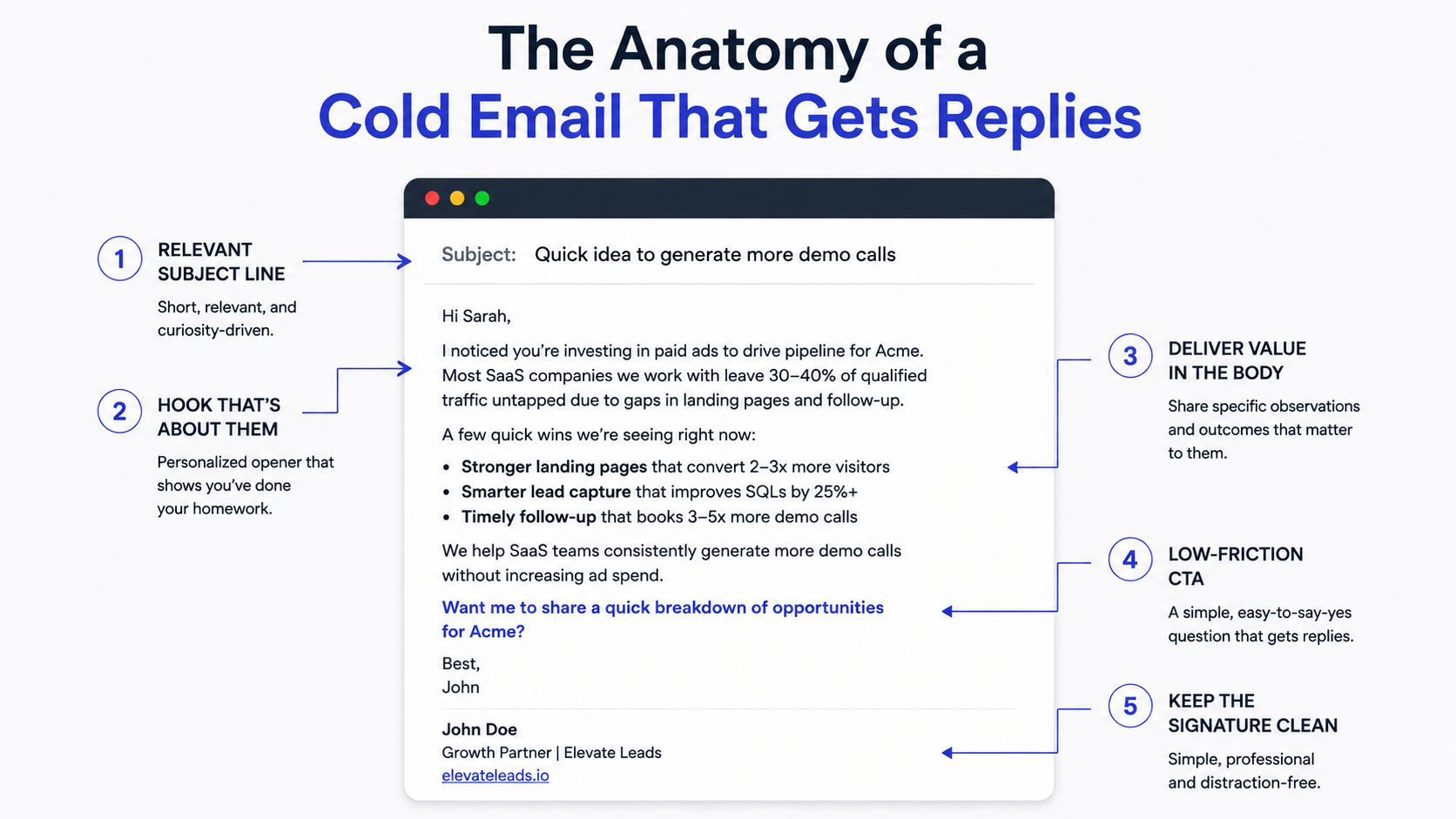
The subject line is the only thing your prospect sees before deciding to open or delete.
You have under one second to make it work. That's roughly 3 to 5 words of real estate.
The goal isn't to be clever. It's to look like an internal email from a colleague.
Most cold email subject lines fail because they signal "this is a sales email."
Once the prospect's brain categorizes it that way, the email gets archived. It doesn't matter how good the body copy is.
Best practices for cold email subject lines:
The strongest subject lines create a small gap of curiosity.
Just enough that the prospect opens the email to find out what it's about.
The hook is where most cold emails die. On mobile, the opening line is the only text visible in the preview. If it doesn't grab the reader, the rest never gets seen.
The biggest mistake is leading with yourself. "Hi, my name is Mark, and I run an agency that helps businesses like yours generate more leads." That's a cold email pattern. Gone in half a second.
A strong hook flips this entirely. It starts with the prospect's world. It references something specific about their business.
Best practices for cold email opening lines:
The best opening lines make the prospect think, "How did they know that?" Not "here comes another pitch."
The body is not a sales pitch. It's a value delivery mechanism.
This is where you prove to a stranger that you have something useful to offer. The entire body should stay under 100 words. If the recipient scrolls to finish reading, the email is too long.
Most cold emails fail here because they default to feature-dumping. "We're a full-service agency that leverages our proprietary AI-powered platform." That's jargon. It tells the prospect nothing about their situation.
What works instead is 2 to 3 observations tied to outcomes the prospect cares about. Their outcomes. Framed in terms of money, time, or competitive advantage.
Best practices for cold email body copy:
The body should leave the prospect thinking, "This person understands my business." That earns the right to make an ask.
The CTA should be the smallest possible ask. Something the prospect can say yes to in three seconds on their phone.
This is where most senders overreach. They ask for a 15-minute call or a demo before earning any trust.
Put yourself in the prospect's shoes. A stranger emailed you. They want you to open your calendar and commit 15 minutes. You're not sure you need the conversation.
The answer is almost always no. Not because they don't need what you offer. Because the ask is too big for the trust you've built so far.
Best practices for cold email CTAs:
Emails that offer real deliverables in the CTA outperform calendar-ask emails. The resulting meetings tend to be higher quality too. The prospect has already self-selected into the conversation.
Your signature should identify you and get out of the way. Three lines maximum.
Full name, title, and company, one link. No motivational quotes. No banner images. No social media icons.
Every extra link and image is another element spam filters evaluate. Leaner is always safer in cold outreach. Switch to your full signature once a real conversation begins.
The anatomy tells you what parts to include. Frameworks tell you how to arrange those parts.
Think of the anatomy as the ingredients. The framework is the recipe. Different situations call for different recipes.
Here are five proven frameworks based on your prospect's awareness level and the type of outreach you're running.
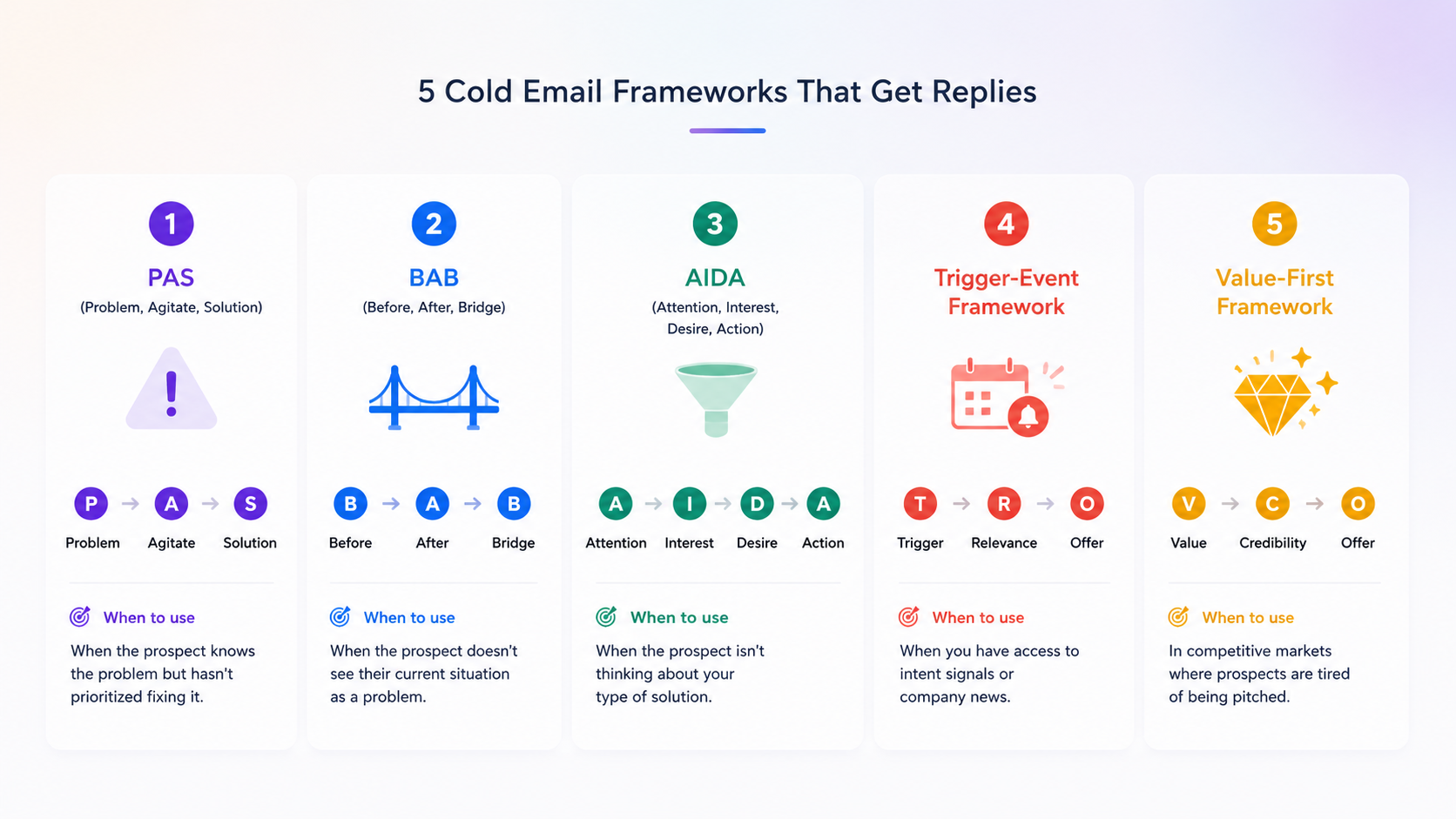
PAS mirrors how people naturally make decisions. You name a problem. You show the cost of leaving it unsolved. Then you offer a way out.
The structure:
When to use it: The prospect knows they have a problem but hasn't prioritized fixing it. The agitation step moves them from awareness to action.
Example:
Hi [First Name], noticed your checkout flow has four steps. Most top-converting stores in [industry] run two.
Every extra step typically costs about 10% of the cart. That adds up fast at your traffic levels.
I can put together a streamlined mockup at no cost. Worth a look?
BAB paints a picture of transformation. You show where they are now. Then where they could be. Then you position yourself as the bridge.
The structure:
When to use it: The prospect may not see their current situation as a problem. The "after" creates a contrast that makes the gap impossible to ignore.
Example:
Hi [First Name], most [industry] companies running paid ads see a 2 to 3% landing page conversion rate. Your top competitors are hitting 7 to 8%.
The difference usually comes down to three things. Social proof placement. Form length. Page load speed.
We helped [similar company] close that gap in 45 days. Want me to show you what we changed?
AIDA is a classic marketing framework adapted for cold email. It walks the reader through a sequence that builds momentum toward a next step.
The structure:
When to use it: The prospect isn't thinking about your type of solution. AIDA gradually educates and engages rather than jumping to a pitch.
Example:
Hi [First Name], 73% of buyers choose the first vendor that adds value to their research process.
I noticed [Company] is expanding into [new market]. That usually means inbound questions are increasing without a scalable content system yet.
We helped [similar company] build that system. It generated 40 qualified leads in the first month.
Want me to share the playbook we used?
This is the highest-performing approach in 2026. It ties your outreach to something that just happened at the prospect's company.
Instead of reaching out cold, you reach out at the exact moment a relevant event makes your offer timely.
The structure:
When to use it: You have access to intent signals and company news. Signal-based campaigns using this approach consistently hit 15 to 25% reply rates.
Example:
Hi [First Name], congrats on the Series B. Scaling the sales team post-funding usually means outbound needs to ramp fast.
We helped [similar company] go from 0 to 50 booked meetings per month within 60 days post-funding. We set up their outbound infrastructure and the first three campaigns.
Would it be helpful to see how we structured it?
This framework skips problem framing entirely. You lead with 2 to 3 actionable ideas the prospect can use right now. Even if they never reply.
It builds trust immediately. It positions you as someone who gives before they ask.
The structure:
When to use it: Competitive markets where prospects are tired of being pitched. Leading with real value sets you apart from every other email asking for something.
Example:
Hi [First Name], I took a quick look at [Company]'s site and had three thoughts:
I work with e-commerce brands on exactly this. Happy to build a mockup at no cost. Want me to put it together?
Templates give you a starting point. But they only work when you understand the structure behind them.
Here are four ready-to-use templates for the most common scenarios. Each includes a breakdown of what makes it effective.
What's working here: The subject line is short and looks internal. The opening references something specific about their page. The body offers two observations tied to metrics. The CTA offers a free mockup that requires nothing except a yes.
What's working here: It ties to a real event at their company. It names a pain point connected to that event. The social proof is concrete. The CTA asks for interest, not a call.
What's working here: It references a specific project, not generic enthusiasm. It leads with a measurable accomplishment. The ask is a conversation, not "please hire me."
The same framework applies to job outreach. But the "value" shifts to what you can specifically contribute. Email the hiring manager directly, not the generic HR inbox.
What's working here: It's under 75 words. The connection between their work and your studies shows genuine interest. The ask is a brief chat, not the internship itself.
Most replies don't come from the first email. They come from follow-ups.
Instantly's 2026 benchmark data shows 58% of replies come from step one.
That means a significant chunk still comes from subsequent touches. Stopping after one send leaves conversations on the table.
Two follow-ups. Same thread. Same subject line. Spaced 2 to 3 days apart.
After two unanswered follow-ups, recycle the prospect into a new campaign. New angle. New subject line. New value proposition.
"Bumping this to the top of your inbox" adds nothing. It signals you have nothing else to offer.
Best practices for cold email follow-ups:
This is the section most guides skip. It's also the reason many well-written emails never get seen.
Your copy might be perfect. But if your sending infrastructure is broken, the email lands in spam. The prospect never knows you reached out.
These email authentication protocols tell email providers that your messages are legitimate. Without them, Gmail and Yahoo will flag or reject your emails.
This isn't an optimization. It's a prerequisite. Every sending domain needs all three configured before a single outreach email goes out.
If your main domain gets flagged for spam, it affects everything. Customer support emails. Transactional emails. Internal communication.
Use secondary domains for outreach. Set them up to redirect to your primary website. Prospects who check the domain will still see a legitimate business.
A new mailbox sending 50 cold emails on day one is an immediate red flag. Every inbox needs a gradual warm-up period first.
That means sending and receiving normal emails. Building engagement patterns. Establishing a reputation before outreach begins.
Sending 10,000 generic emails and hoping for 50 replies now destroys your sender reputation. It burns your domains too.
Spam filters in 2026 detect templated patterns. They flag high-volume senders. They penalize domains with low engagement.
The senders hitting 15 to 25% reply rates are sending fewer emails. They're targeting better prospects. And their messages feel genuinely relevant.
Learn how many cold emails to send per day
Every sales rep now has tools that generate hundreds of "personalized" emails in minutes. Inboxes are drowning in messages that all sound the same.
They're polished. Perfectly structured. And completely generic.
If your email reads as if a language model wrote it, the prospect filters it out before finishing the first sentence.
Why This Matters for Your Writing
Spam filters in 2026 evaluate more than content. They check the sender's reputation. Authentication status. Sending patterns. Domain age. Engagement metrics.
You could write the most compelling cold email ever. It still won't get a reply if the domain isn't authenticated or the inbox isn't warmed up.
Writing and infrastructure are two sides of the same coin.
Setting up all of this manually takes hours per domain. Purchasing domains. Configuring DNS. Creating mailboxes. Managing warm-up.
Mailforge automates domain creation, DNS configuration, and mailbox provisioning. Teams can have outreach-ready infrastructure in minutes instead of days. That frees you to focus on what actually moves the needle: writing better emails to better-targeted prospects.
Even solid strategies get undermined by avoidable errors. Here are the seven mistakes that consistently kill reply rates.
The entire playbook fits in two sentences.
Write something genuinely relevant to the person reading it. Make sure the email actually reaches their inbox.
Most senders only focus on one side. Getting both right separates a 1% reply rate from a 15% one.
Pick one of the five frameworks above. Write your first email using the anatomy structure. Send it to someone you've actually researched.
But none of that matters if your sending infrastructure isn't set up right.
Unauthenticated domains, cold inboxes, and broken DNS records will bury even your best emails in spam.
That's the part most people get stuck on. Purchasing domains. Configuring SPF, DKIM, and DMARC. Creating mailboxes. Managing warm-up. Doing it manually across multiple domains takes hours and leaves room for mistakes that quietly kill deliverability.
Mailforge handles all of it in minutes.
Automated domain creation, DNS configuration, and mailbox provisioning, so your infrastructure is outreach-ready from day one.
That frees you to focus on what actually moves the needle: writing better emails to better-targeted prospects.
Aim for 75 to 100 words in the initial send. If it requires scrolling on mobile, you've lost most readers. Say what you need to say. Offer something specific. Make it easy to reply.
Two follow-ups are the sweet spot. Same thread. Spaced 2 to 3 days apart.
After two unanswered follow-ups, move the prospect into a new campaign. Use a different angle and fresh messaging.
Yes. But the bar has risen significantly.
The average reply rate sits at 3.1 to 3.43%. Signal-based campaigns with strong personalization consistently hit 15 to 25%.
Generic AI-generated outreach has flooded inboxes. Cold emails that are specific, timely, and relevant stand out more than ever.
The industry average is 3.1 to 3.43%. A well-optimized campaign should aim for 5 to 10%.
The top 10% of senders exceed 10% reply rates. Signal-based approaches that time outreach to buying events consistently achieve 15 to 25%.
AI is excellent for research and lead enrichment. It can pull company summaries, identify recent news, and surface relevant signals.
But AI-written copy often sounds polished yet generic. That's exactly the pattern prospects have learned to ignore.
Use AI as a research assistant. Then write the email yourself in your own voice.