Here’s a more founder-led version that sounds like you’re talking to someone who is actually making the buying decision, rather than introducing a comparison article:
Infraforge is one of those names that keeps coming up when you start looking for cold email infrastructure.
And I get why.
You get dedicated IPs, automated DNS setup, prewarmed domains, and a support team that actually understands cold outreach. On paper, it checks almost every box.
But when a founder tells me they are looking for Infraforge alternatives, I usually don't start with deliverability.
I ask them to show me what they are paying.
Because the math can change pretty quickly.
Four dollars per mailbox sounds reasonable. Then you add a dedicated IP for $99 a month. Then domain masking at $2 per domain when you are running 17 domains.
Suddenly, that $200-ish infrastructure bill is closer to $333.
And if those extra costs are not giving you more replies, more meetings, or more pipeline, it is fair to ask what exactly you are paying for.
That is the lens I used for this comparison.
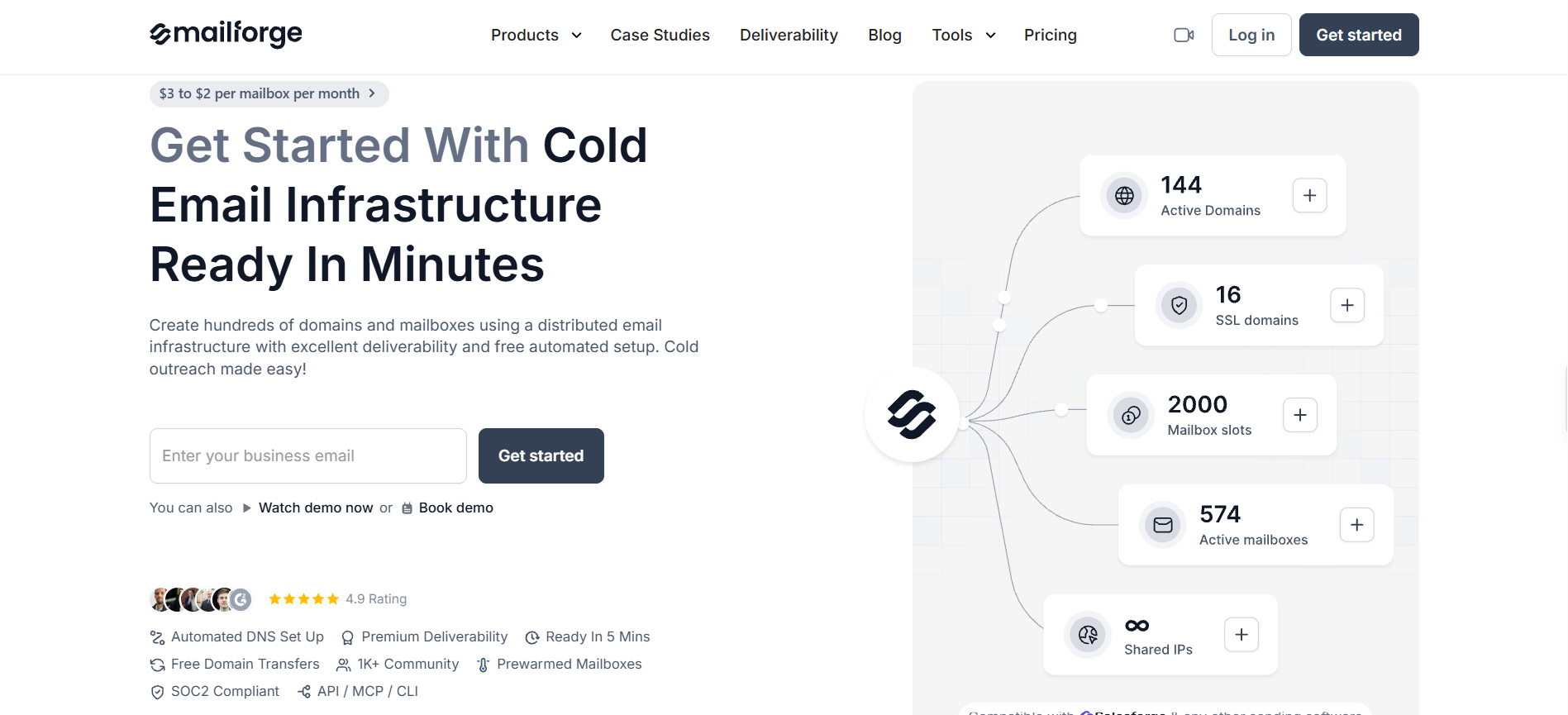
If cost is the reason you are leaving Infraforge, Mailforge is the obvious place to look first. It gives you five-minute provisioning, automated DNS, and bulk domain tooling at $3 per mailbox, without the separate IP charge. At 50 mailboxes, I found a $183 monthly difference using both pricing calculators.
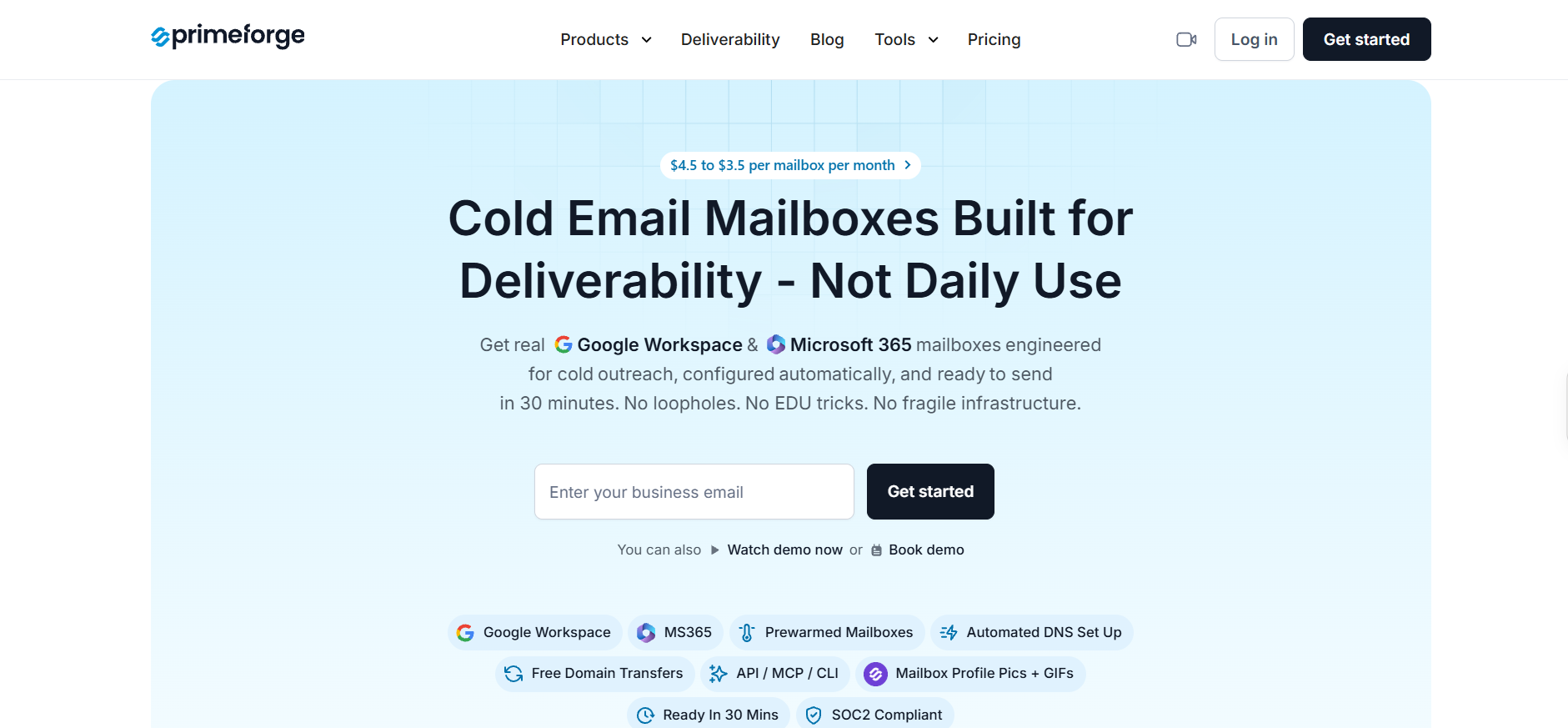
If the problem is that you need Google Workspace or Microsoft 365 mailboxes, the calculation is different. That is where Primeforge comes in, because you are solving a capability gap rather than simply looking for a cheaper version of Infraforge.
I also looked at four other options, including two that can come in below Mailforge depending on how you build your setup.
So instead of giving you another generic list of "best Infraforge alternatives," I broke down what each one actually costs at 50 and 200 mailboxes, what you get for that money, and what users are saying once they have actually used them.
I built the same setup in every pricing configurator. Fifty mailboxes, three per domain, seventeen domains. Then the same again at two hundred.
That exposes things a pricing page will not. Maildoso has no tier between 30 and 300 mailboxes, so 50 costs the same as 300. Mailreef needs a second server at 200, which doubles the base before a single send fee.
I checked what each tool bundles against what it bills separately, because warmup, masking, and unified inbox are where the surprises sit.
I read G2 and Trustpilot from the last twelve months, looking for failures that repeat rather than one angry quarter.
And I looked at commitment terms, since switching infrastructure twice costs more than picking correctly once.
6 Best Infraforge Alternatives in 2026
1. Mailforge
Mailforge is the best Infraforge alternative because it is the only switch here that changes nothing about how you work, and because it removes the exact line item that pushed you to start looking.
Same provisioning engine. Same automated DNS. Same bulk domain tooling, same API and CLI, same support team behind it. You drop the $99 IP and keep every workflow you already built.
That matters more than the saving, and here is why. Every other tool on this list asks you to accept a new failure mode in exchange for a lower bill.
Maildoso hands you domains that reviewers have found already blacklisted. Inframail locks you to Microsoft inboxes and moves warmup behind a $3,497 tier. Mailreef sets a $240 floor before your first send.
Mailforge asks you to give up one thing, and it is the thing you were probably not using. An isolated IP only pays off once you have the volume to keep it warm.
Propeller is the case I keep coming back to on this. They scaled from 500 to more than 10,000 customers running outreach on Mailforge infrastructure, holding inbox placement the whole way. That is shared IP performance at a volume most teams never reach.
So the number lands as a consequence rather than the pitch. At 50 mailboxes with a dedicated IP and masking on Infraforge, you pay $333 a month. The same setup on Mailforge is $150.
Key features I liked:
Domains and mailboxes live in roughly five minutes, no registrar work
SPF, DKIM and DMARC written automatically on every domain added
Bulk DNS updates across hundreds of domains in one action
Mailboxes arrive prewarmed, so no two week wait before sending
Works with any sending tool, no lock-in to one sequencer
SOC2 compliant, which matters when you sell into regulated buyers
Pros
At 50 mailboxes with a dedicated IP and masking on Infraforge, Mailforge comes in $183 a month cheaper for the same provisioning experience.
Prewarmed mailboxes are included rather than sold as a separate managed service.
Bulk DNS updates genuinely save hours once you are past fifty domains.
Nothing about your sending workflow changes, since the mailboxes plug into whatever sequencer you already run.
Cons
The shared pool means you inherit other senders' behaviour, and reviewers have reported batches of mailboxes blocked together on the same day.
Past 200 mailboxes both Maildoso and Inframail cost significantly less.
There is no free trial and no money back guarantee, exactly like Infraforge.
The $2 per mailbox volume rate is advertised without publishing the count that unlocks it.
Pricing:
Mailbox slots: $3 - $2 per mailbox per month, 10 slot minimum
Domains: $14 per year per .com, purchased separately
Bonus read: if you are also weighing mailbox providers outside this list, the comparison of Inboxkit alternatives covers more of them.
2. Primeforge
Primeforge exists on this list of Infraforge alternatives for a reason..
You get real Google Workspace and Microsoft 365 mailboxes.
These are accounts hosted by Google and Microsoft themselves, not SMTP mailboxes running on a provider's own servers. That distinction is what Gmail and Outlook filters respond to, and it is the one thing Infraforge cannot offer at any price.
I want to be clear that this is not a cheaper option. It is more expensive than Infraforge per mailbox. You pay the premium because mainstream provider mailboxes behave differently in Gmail and Outlook filters, and because some buyers will not accept anything else.
Key features I liked:
Real Google Workspace mailboxes, no loopholes or EDU tricks
Real Microsoft 365 mailboxes for teams standardised on Outlook
SPF, DKIM and DMARC configured automatically at setup
US IP addresses on every mailbox
Profile pictures and GIFs preloaded, so inboxes do not look empty
Ready to send in about thirty minutes from signup
Pros
Solves the one thing Infraforge cannot do, with mainstream provider mailboxes rather than a workaround.
Thirty minute setup is fast for Workspace provisioning, which normally means a day of admin console work.
US IPs and preconfigured profile identities remove two common cold outreach tells.
Mailboxes are legitimate accounts, so they do not break when Google changes policy.
Cons
It is the most expensive option per mailbox on this list, roughly 50% above Mailforge.
Setup takes thirty minutes against five, because provisioning real Workspace accounts is slower.
There is no dedicated IP path, so this is not a like for like replacement if isolation is why you bought Infraforge.
No G2 profile exists yet, which limits independent verification.
Pricing:
Mailbox slots: $4.50 - $3.50 at volume
Domains: $14 per year per .com
Bonus read: the list of Primeforge alternatives compares Google and Microsoft mailbox providers side by side.
3. Maildoso
The cheapest alternative to Infraforge is Maildoso.
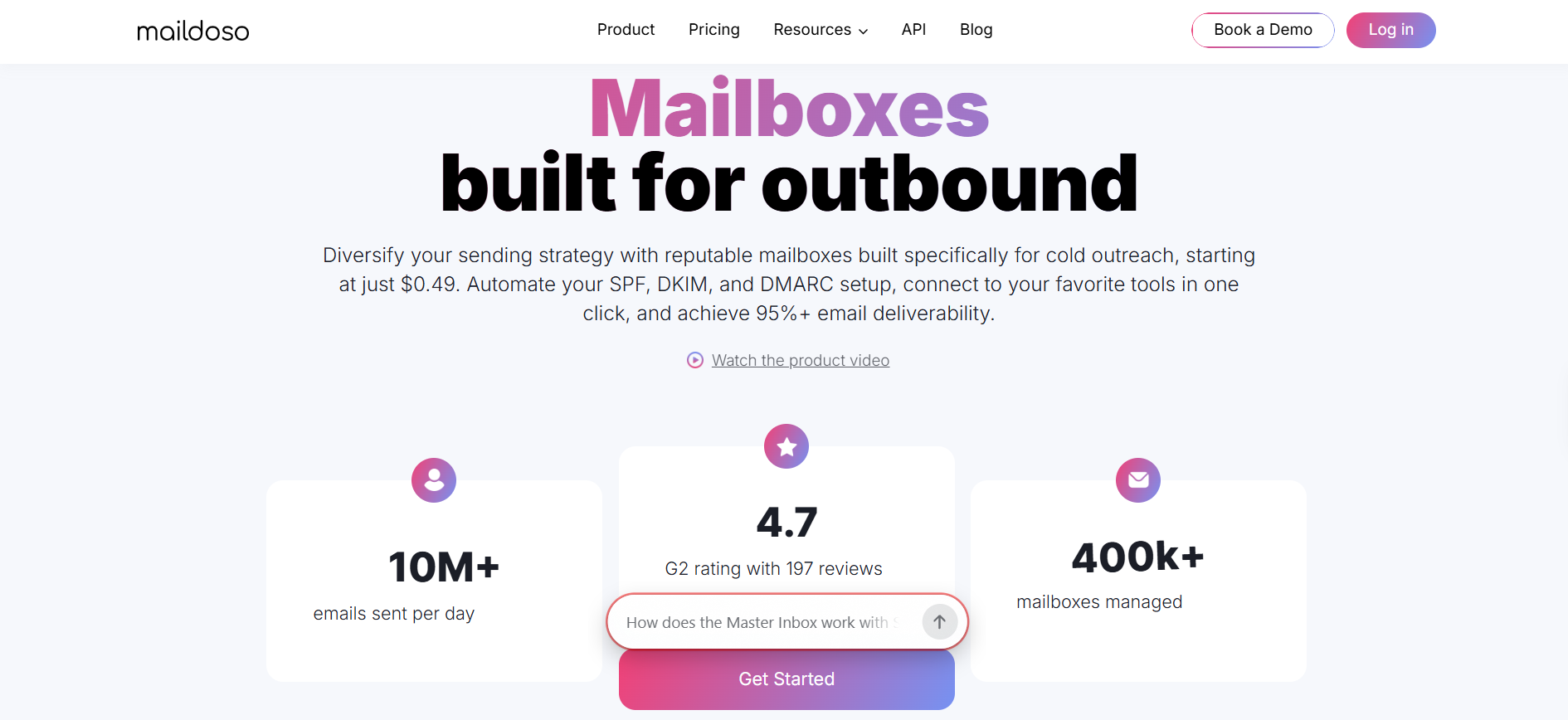
It sells 300 mailboxes for $225 a month. That is $0.75 each, roughly a fifth of what Infraforge charges, and the pricing is not a gimmick.
The problem shows up in what arrives. Several reviewers describe domains landing already blacklisted, which is the failure mode shared infrastructure produces when the pool gets crowded.
Key features I liked:
One click connections to Instantly, Smartlead and Saleshandy
Self healing mailboxes that repair broken configurations automatically
IP rotation built into the infrastructure layer
CAPTCHA protection sitting in front of your sending domains
Free deliverability audits included on every plan
Thirty day money back guarantee, which nobody else here offers
Pros
Per mailbox cost at volume is the lowest here by a wide margin, and the pricing is fully published.
The thirty day guarantee removes the risk that Infraforge's no trial policy creates.
Integrations with the major sequencers are genuinely one click, with no SMTP credential handling.
Free deliverability audits give you a health read without buying a monitoring tool.
Cons
The 15 emails per mailbox per day cap means you need far more mailboxes to reach the same volume.
There is nothing between the 30 and 300 mailbox tiers, so fifty mailboxes costs what three hundred costs.
Pricing:
30 mailboxes: $75 a month, or $2.50 each
300 mailboxes: $225 a month, or $0.75 each
1,000 mailboxes: $499 a month, or $0.49 each
Domains: $12 a year, rising to $15
Custom packages from $0.49 per mailbox
Bonus read: the comparison of Mission Inbox alternatives covers cheap mailbox providers in more depth.
4. Inframail
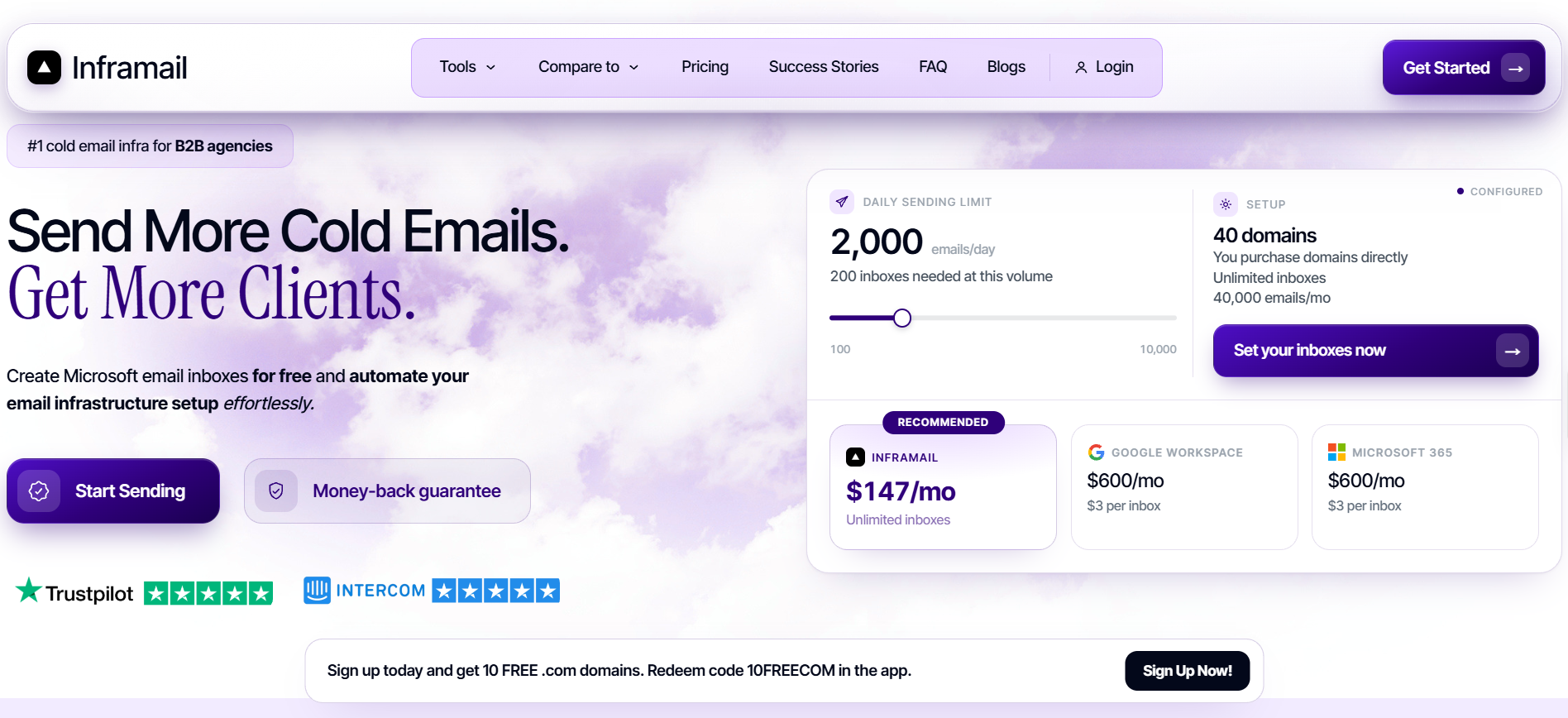
Inframail is a cost-effective alternative to Infraforge. It gives you a dedicated US IP for $147 a month with unlimited inboxes, against $200 in slots plus $99 for the IP on Infraforge.
Half the price for the thing you were paying Infraforge to get.
Then I looked at what is not in that $147. Warmup sits in the done-for-you tier at $3,497 one time, or $499 a month. The base plans do not include it.
That is the problem, and it is not a minor omission. A dedicated IP starts at zero reputation and only becomes an asset once you warm it properly. Selling the IP without the warmup hands people the hardest part of dedicated sending and none of the tooling.
So the real comparison is not $147 against $299. It is $147 plus whatever warmup costs you, on infrastructure where the warmup is the failure point.
Key features I liked:
Unlimited inboxes with no per inbox charge at any tier
Dedicated US IP included, one on Unlimited and three on Agency Pack
Domain to inbox in 180 seconds
Blacklist auto delisting, with a claimed 68.3% success rate
A one to one deliverability consultant on every plan
Ten free .com domains at signup, at time of writing
Pros
Dedicated IPs are included rather than a $99 add-on, which is the most direct answer to Infraforge's pricing complaint.
Flat rate pricing means your effective cost per mailbox falls every time you add one.
The deliverability consultant is bundled rather than sold as consulting hours.
Setup at 180 seconds is the fastest published time of any tool here.
Cons
Trustpilot reviewers report accounts blacklisted during or shortly after warmup, with support unable to resolve it.
Inboxes are Microsoft backed only, so there is no Google Workspace path.
Warmup sits behind the $3,497 done for you tier rather than the base plans.
No G2 profile exists, which limits verification if your buying process requires it.
Pricing:
Unlimited: $147 a month, 80,000 emails, 1 dedicated IP
Agency Pack: $387 a month, 300,000 emails, 3 dedicated IPs
Annual billing: 30% off both plans
Existing domains: $5 one time connection fee each
Done for you setup: $3,497 one time or $499 a month
5. Mailreef
Every customer gets screened and approved before they are allowed to buy. That single policy tells you more about Mailreef than its feature list does.
You are not renting a slice of shared infrastructure. You get a dedicated mail server with its own IP, and your neighbours have been vetted.
For an agency that got burned when somebody else on the pool started sending badly, that isolation is the entire product. The floor price is the catch.
Key features I liked:
A fully dedicated server with its own IP, no shared resources at any layer
150 or more mailboxes on a single server
Domain and mailbox spin-up in 30 seconds through the API
SMTP and IMAP credentials on every mailbox
Delivery consulting and live technical support included
Customer screening, which keeps bad senders off your server
Pros
Server level isolation goes further than a dedicated IP alone, which is what Infraforge sells.
The screening process means your server neighbours have been checked rather than simply paid.
At full 150 mailbox capacity the effective rate lands near $1.60 per mailbox.
Month to month costs only $9 more than the annual commitment, which is unusually fair.
Cons
The $240 floor makes no sense below roughly sixty mailboxes, which they acknowledge themselves.
Per send billing at $0.001 adds roughly $220 a month at 200 mailboxes.
Domain pricing is not published anywhere, so you cannot budget the full cost before signing up.
There is no G2 or Trustpilot profile, so no independent review record exists to check.
Pricing:
Agency: $240 a month plus $0.001 per email, twelve month commitment
Agency Flex: $249 a month plus $0.001 per email, cancel anytime
If Primeforge is outside the budget, Zapmail is the other route to real Google and Microsoft mailboxes.
It sits last on this list rather than out of it, because the capability is genuine even though the review record is the weakest here.
I would still shortlist it if price is the binding constraint. I would also order ten mailboxes and check the sending IP before I ordered a hundred.
Key features I liked:
Real Google Workspace and Microsoft 365 mailboxes, not SMTP substitutes
One click export to more than fifty outreach tools through OAuth
Full admin access, so the mailboxes stay yours
Deliverability test credits included on every tier
One domain per workspace, which isolates reputation between clients
Automated DNS across every domain you add
Pros
Real Workspace and Microsoft 365 mailboxes at a lower entry price than Primeforge.
Full admin access means the accounts stay under your control rather than a reseller's.
Export to fifty or more sequencers through OAuth removes credential setup entirely.
At 50 mailboxes it undercuts Infraforge by $36 a month before Infraforge's add-ons.
Cons
Trustpilot reviewers repeatedly report mailboxes provisioned on Indian IPs despite the US hosting claim.
All purchases are final and non-refundable, which is harsher than simply having no trial.
One reviewer described being unable to release Workspace accounts when moving away.
The 3.9 G2 rating is the lowest here, and that listing appears to mix in a different product's reviews.
Pricing:
Starter: $39 a month for 10 mailboxes, extras at $3.50
Growth: $99 a month for 30 mailboxes, extras at $3.25
Pro: $299 a month for 100 mailboxes, extras at $3.00
Domains: $15 a year
Final Verdict
Mailforge is my pick. It delivers the same provisioning and DNS automation as Infraforge at roughly half the real monthly cost once the IP and masking add-ons are counted.
Primeforge is the answer if you need Google or Microsoft mailboxes, since that is a capability gap rather than a pricing one.
Maildoso wins on raw cost past 200 mailboxes. Inframail wins on dedicated IP value. Mailreef wins on isolation.
For most teams leaving Infraforge over cost rather than capability, Mailforge is the closest move.
Mailforge, for most teams. Same automated DNS, bulk domain management and five minute provisioning at $3 per mailbox against Infraforge's $4, with no $99 dedicated IP add-on.
Why do people switch away from Infraforge?
Two reasons dominate. Add-on costs climb quickly once dedicated IPs and domain masking are added, and there is no Google Workspace or Microsoft 365 mailbox option.
Is Infraforge expensive?
Base pricing is $4 per mailbox with a ten mailbox minimum. The real number depends on add-ons. Fifty mailboxes across seventeen domains with an IP and masking comes to about $333 a month.
Which Infraforge alternative is cheapest?
Maildoso, at $0.75 per mailbox on the 300 mailbox plan. Several reviewers report receiving domains already on blacklists, so check every domain on day one.
Can I get Google Workspace mailboxes instead of SMTP?
Not from Infraforge, which sells custom domain SMTP only. Primeforge and Zapmail both provide real Google Workspace and Microsoft 365 mailboxes.
Does Infraforge offer a free trial?
No. You buy domains and mailboxes to use it, though you can explore the app after signing up. Maildoso is the only tool here with a thirty day money back guarantee.
Do I actually need dedicated IPs for cold email?
Only past roughly 30,000 emails a month, or when you run separate client accounts. Below that a cold dedicated IP often performs worse than a well managed shared pool.