
Before we get into how you can do effective, scalable email outreach, let’s first understand the environment Series A startups currently operate in.
In 2025, the top 10% of startups raised around 50% of all capital. And the bottom 50% raised only 14%.
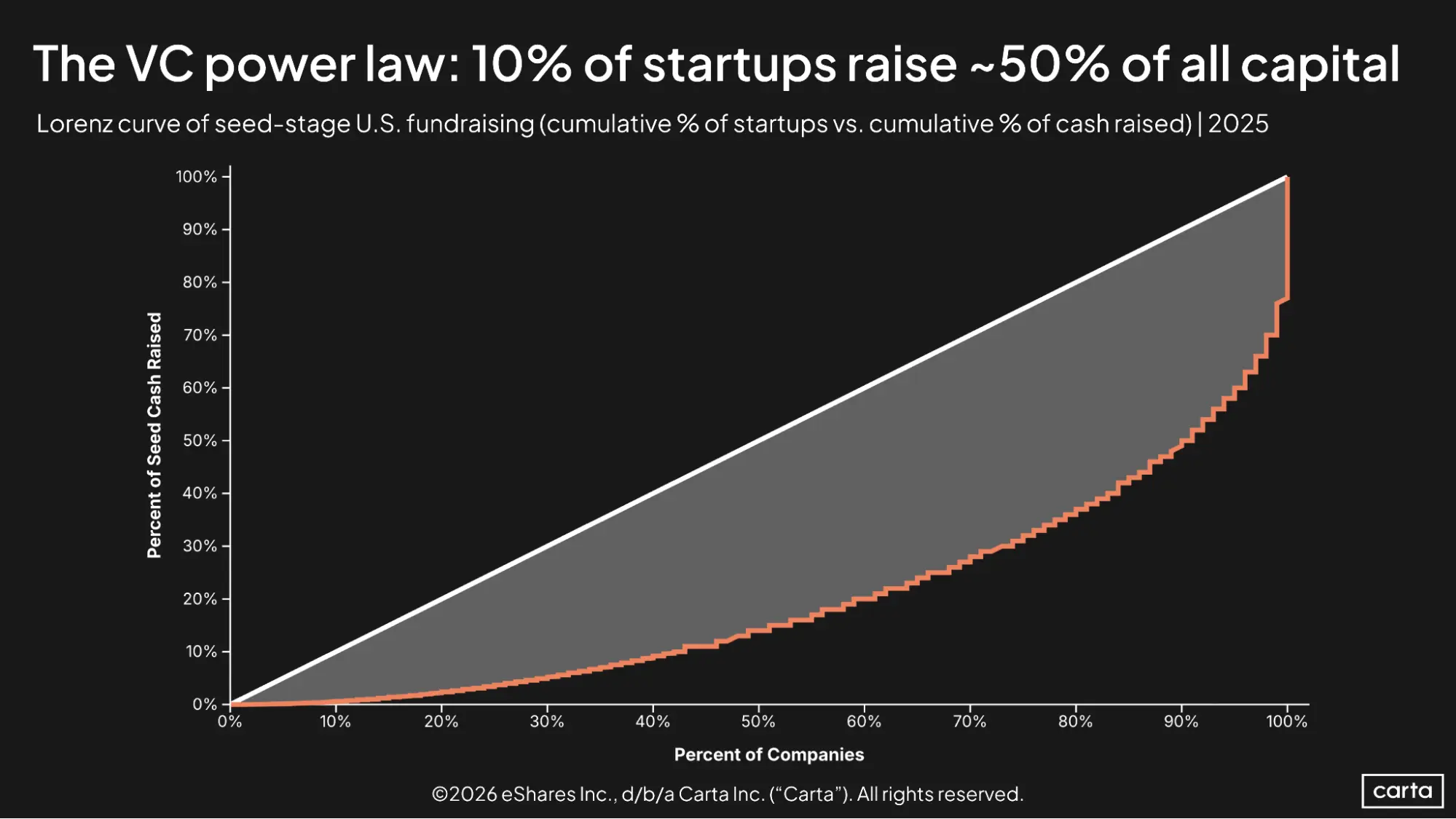
Source: Carta
At the same time, Series A median post-money valuation was up 37% year-over-year, reaching $78.7M in Q4 2025.

Source: Carta
What does this actually mean for Series A startups? It means that, on average, investors are making fewer but more concentrated, larger bets.
It’s not like the “spray-and-pray” approach we’ve seen in the early 2020s.
So, if your startup has raised Series A in this economy, it could feel like there is even more pressure on you than before. As investors place bigger bets, their expectations are generally higher as well.
We understand that you already knew that it was quite tough out there without this research.
But actually, it’s a good thing. How come? First of all, you’re not alone. And secondly, you’ve already got funding and trust from your investors.
After reading this guide, you’ll also understand how to scale email outreach without damaging your sender reputation. So, let’s get right into it.
Sender reputation is essentially how credible your domain and IP are in the eyes of mailbox providers.
You can’t ignore it because your email deliverability depends on your sender reputation.
If Google, Outlook, and other email providers don’t trust you, your messages are much more likely to be rejected or get into spam.
And email warm-ups won’t really help you in the long run. You have to build an effective email infrastructure to get good and long-lasting results from your outreach efforts.
So, if you want to improve email deliverability, you have to work on your reputation first. This includes:
Here is a thing: 78% of startups with a successfully built product and defined product-market fit still fail to scale (McKinsey research).
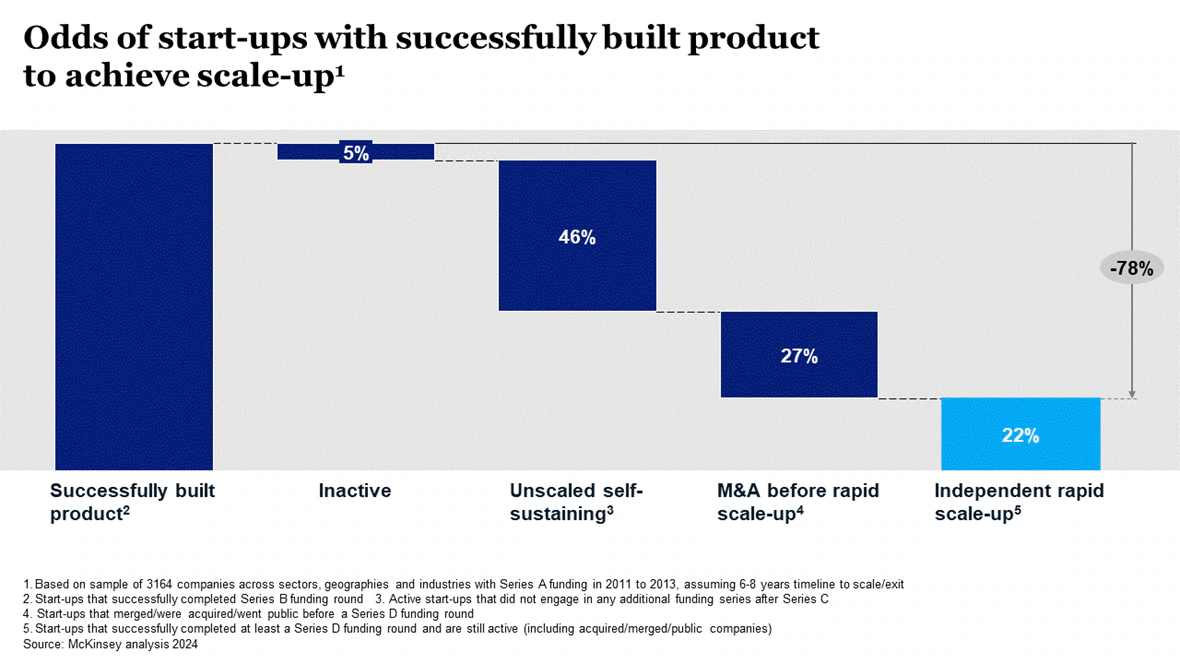
Source: McKinsey
So, for many startup teams, there is a moment when they understand that scaling just doesn’t work as they hoped.
And what’s their first instinct? Usually, it’s to double down on everything they're doing.
Email outreach is usually perceived as one of the most scalable channels. That’s why you’d often see Series A startups start sending more emails, just for the sake of it.
Now, it’s especially easy with all the AI tools and agents. You can produce virtually unlimited messages and try to “spam your way to the top.”
But unfortunately, this is exactly where your reputation can take a hit:
Essentially, if you try to scale outbound email without good infrastructure, it will backfire. And you’ll almost inevitably waste a ton of money and time.
So, your main objective isn’t to focus on a particular metric or a specific email campaign.
Your goal is to build a solid system that won’t break once you scale.
With that in mind, let’s see exactly how you can scale email outreach without hurting sender reputation in seven simple steps.
Your technical setup is the first thing you need to take care of. Essentially, it comes down to:
This technical part isn’t something you do once and forget about it. So, make sure to run regular checks within your email platform. You can try Warmforge to ensure proper technical setup and email warm-up.
Email outreach for startups often begins with creating a separate domain for cold emails. It is a widely used practice because it gives you the ability to:
Besides, it’s quite easy to do.
Choose any domain that’s similar to yours without looking deceptive. For example, for brandname.com, a second domain name could be brandnametech.com, getbrandname.com, brandname.co, etc.
It’s best to avoid any hyphens or numbers and try to stick to .com or other popular extensions. In case you’re buying a second-hand domain, always check its reputation beforehand.
This way, you can scale with more peace of mind. Because your primary domain will be better protected for any important communications with your existing customers, investors, partners, etc.
Many blame AI for the rise of spammy emails that flood everyone’s inboxes. And it’s true, using AI to mass-produce and send tons of irrelevant emails to the lists you haven’t verified is a horrible idea.
But AI can also be an amazing tool to actually help you make your cold email outreach strategy more efficient.
Here are some of the best use cases:
Many often think that email outreach starts with a warm-up. It’s like you just wait for two weeks or so and start sending your emails. Well…
While you do need to warm up new email inboxes, it can’t replace an entire strategy.
Any effective email outreach starts with a system. Not just a tool. Or a random outreach tactic.
So, these are some of the email outreach best practices that help you systematize your outreach:
The more relevant your messages are, the safer your reputation will be. When a person sees something they actually need, the chances of your email going to spam are much lower.
So, it’s really important to do your research.
Personalization isn’t just about changing the name. It’s about making a person feel like you actually care. So, if you don’t have any insider info, you can reference something like:
Sure, this is a lot of work. But you have to stand out if you want to start any real conversations. Imagine how many AI-slop emails every lead receives on a daily basis. Do you really think they answer those?
There is one huge misconception. Often, startups think that scaling email outreach comes down to the volume of messages they send.
Of course, having a solid infrastructure that allows you to send a lot of emails is important. But the whole point of scaling your outreach isn’t just sending more emails. It’s getting more replies, leads, meetings, and so on.
That’s why you have to measure outcomes instead of activity as such.
This is also what will help your deliverability in the long run. Because the more high-quality and meaningful your email conversations are, the stronger your reputation gets.
So, make sure you encourage actual results by setting proper success metrics.
These can be demo bookings, positive reply rate, SALs, etc. The other side of this is tracking unsubscribes, bounce rates, spam complaints, and other “negative” metrics.
If your reply rates are already falling, you’re probably a little late.
The thing is that good conversion-related metrics are the result of a strong email outreach strategy. It means good technical setup, deliverability, segmentation, personalization, and so on.
If any of those fail, you will eventually feel it in your reply rates or other more tangible KPIs. But the issue that leads to that usually comes up long before the drop you notice.
That’s exactly why when building an email outreach strategy for Series A startups, your monitoring has to be proactive, not reactive. And this is where having a good email tech stack is important. It’ll simply monitor most issues automatically.
Protecting your email sender reputation can sound boring and slow at first.
But in the long run, it’s what differentiates successful startups from those that struggle to scale their outreach.
Mailforge is a platform that doesn’t offer temporary fixes.
It’s a tool that helps you build an infrastructure that can easily support scalable email outreach for startups.
And once you have that foundation, your recipients will actually get your messages, instead of losing them in a spam folder.