If you are searching for Inframail alternatives, you are probably looking for a more flexible setup, a lower starting cost, or an option beyond Microsoft-only inboxes.
Inframail is a dedicated cold email infrastructure provider that offers unlimited email inboxes on Microsoft-backed infrastructure for a flat monthly fee and handles DNS setup for you.
But it has a few limitations:
I compared five Inframail alternatives by infrastructure, mailbox options, monitoring, agentic access, and cost.
If you are short on time, here is where each alternative fits:
Check the table below for a quick comparison of the five tools on infrastructure, pricing, and agentic access.
Now let's look at each tool in detail, starting with what it does, its key features, and what it costs.
Best for: GTM teams and agencies that want dedicated cold email infrastructure with more control over their email setup.
Infraforge provides private SMTP and IMAP infrastructure for cold email outreach. You can create domains and mailboxes in bulk, connect them to your preferred sending platform, and manage the setup from one place.
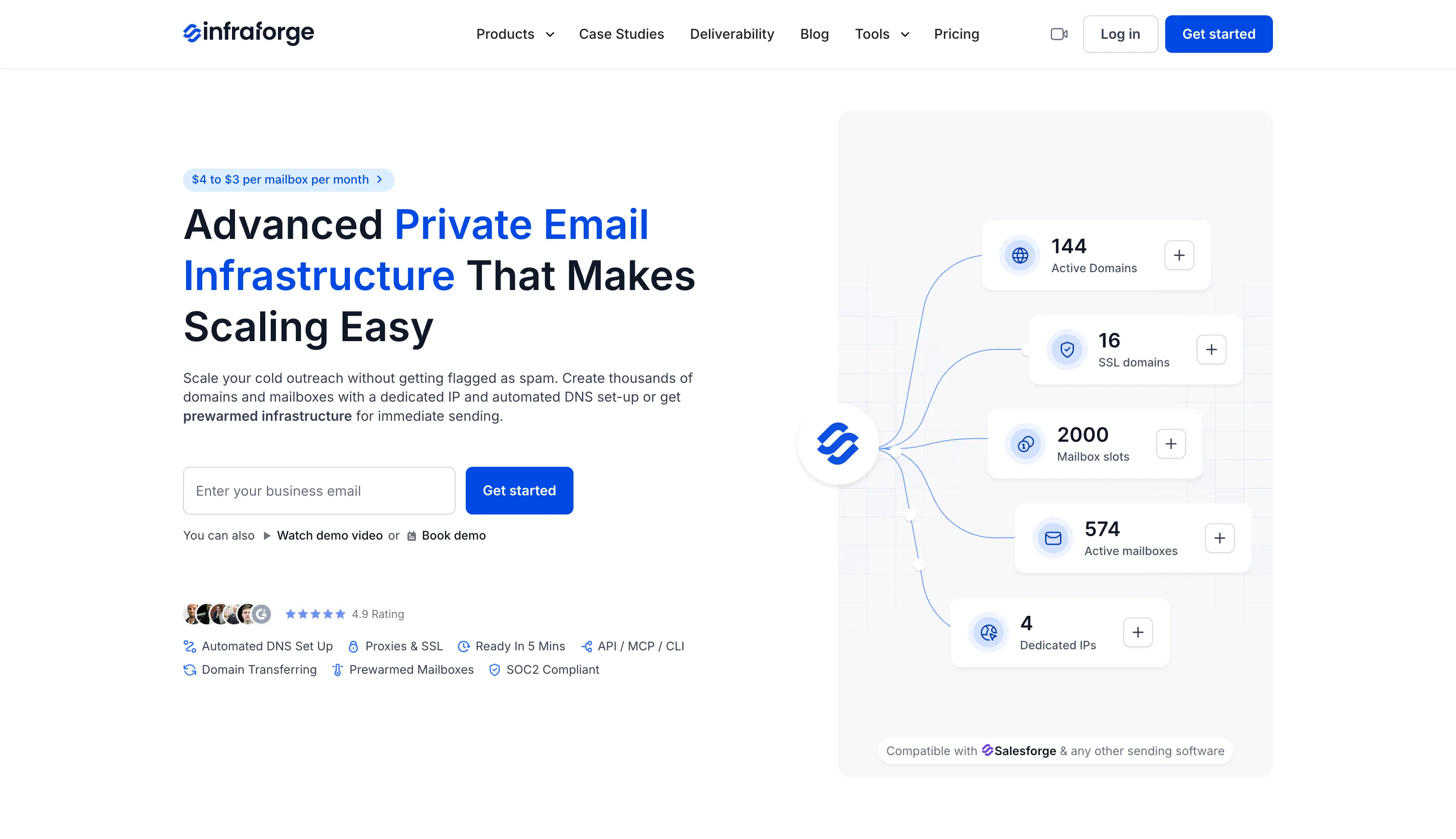
Unlike Inframail, Infraforge does not put a fixed cap on the number of domains and mailboxes you can create. You can also add dedicated IPs and separate your sending infrastructure across different workspaces.
Infraforge also offers pre-warmed domains and mailboxes, so you can start outreach without waiting for new mailboxes to warm up. You can manage your infrastructure manually from the dashboard or use the API, MCP, and CLI to automate the setup.
Key features
Pricing
Infraforge pricing starts at $4 per mailbox per month on quarterly billing, with a minimum of 10 mailbox slots. Annual billing is also available at a lower rate. Additional dedicated IPs cost $99 per month each, and domains are charged separately.
If you are weighing dedicated against shared infrastructure, this Mailforge vs Infraforge comparison walks through the differences.
Best for: Outbound teams and agencies that want affordable email infrastructure for cold outreach.
Mailforge provides distributed shared email infrastructure for cold outreach. You can create domains and mailboxes in bulk and connect them to your preferred sending platform. The setup process, including DNS, is automated.
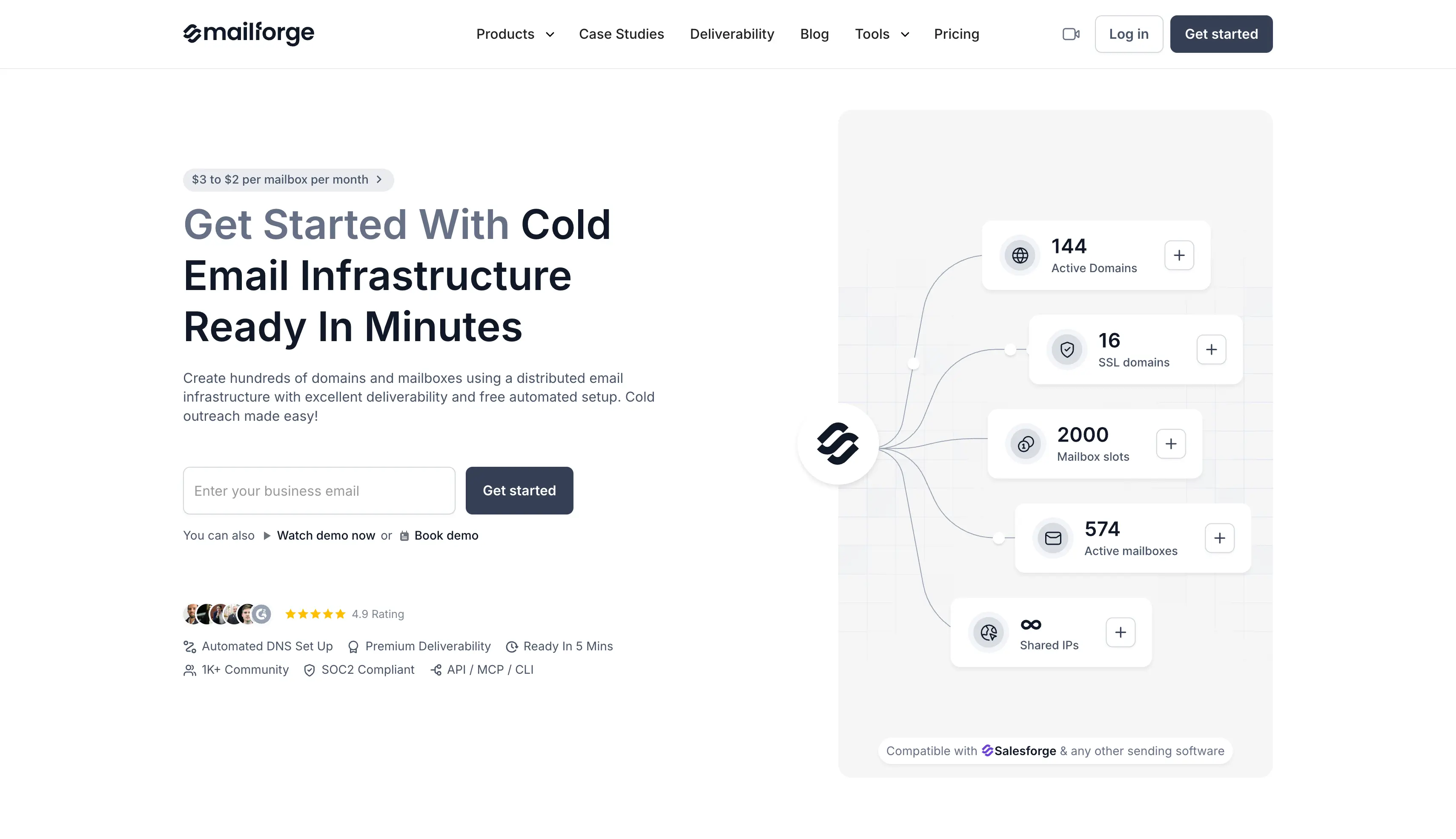
Mailforge uses shared IPs instead of dedicated IPs. This keeps the cost lower for teams that do not need dedicated infrastructure. It also offers pre-warmed mailboxes at the same price as standard mailboxes. You do not pay extra for the pre-warmed option.
You can even manage your Mailforge infrastructure with MCP and CLI, in addition to its API. This gives you more ways to create and manage infrastructure without relying only on the dashboard.
Mailforge is a good alternative to Inframail if you want lower mailbox costs, shared IPs, and pre-warmed mailboxes without an additional fee.
Key features
Pricing
Mailforge pricing starts at $3 per mailbox per month on monthly billing, with a 10-mailbox minimum. Annual billing is also available at a lower rate. Domains and additional features are charged separately.
The Mailforge pricing page has a calculator, so you can see the total for your exact mailbox count before you commit.
Best for: Agencies and teams that want a dedicated mail server with technical support and deliverability help.
Mailreef provides dedicated mail servers and dedicated IPs for cold email. You can bring your own domains or purchase them through Mailreef.
You can also create mailboxes in bulk and connect them to sending platforms such as Smartlead and Instantly. Mailreef handles the required DNS setup for you.
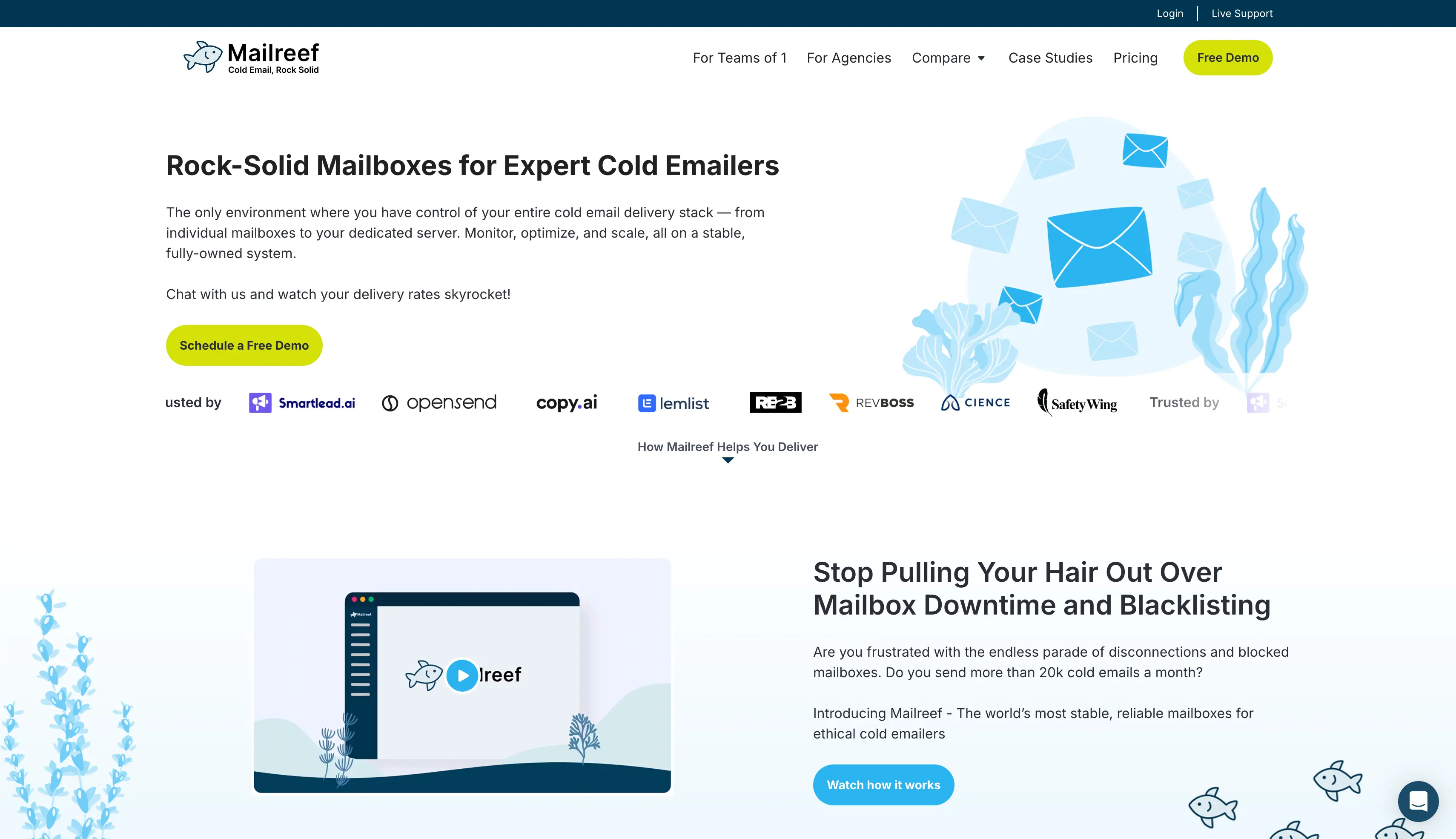
Compared with Inframail, Mailreef gives you a dedicated server environment with technical support, server monitoring, and delivery consulting. It also offers pre-warmed servers, domains, and mailboxes if you want to start with existing infrastructure.
You can manage mailbox provisioning through the Mailreef API. Its mailboxes also support SMTP and IMAP, so you can connect them to compatible sending tools.
I put the two side by side in Mailreef vs Inframail if you want the full breakdown.
Key features
Pricing
Mailreef pricing starts at $249/month on month-to-month billing or $240/month with a 12-month commitment. Both plans charge an additional $0.001 per email sent.
My Mailreef review goes deeper on the server setup and what the support experience is like.
Best for: Teams that want SMTP mailboxes with regular placement checks and automatic recovery for underperforming accounts.
Maildoso provides SMTP mailboxes for outbound campaigns. You can connect your domains, create mailboxes, configure DNS, and export the accounts to your preferred cold email software. It also supports API and MCP access for managing your infrastructure.
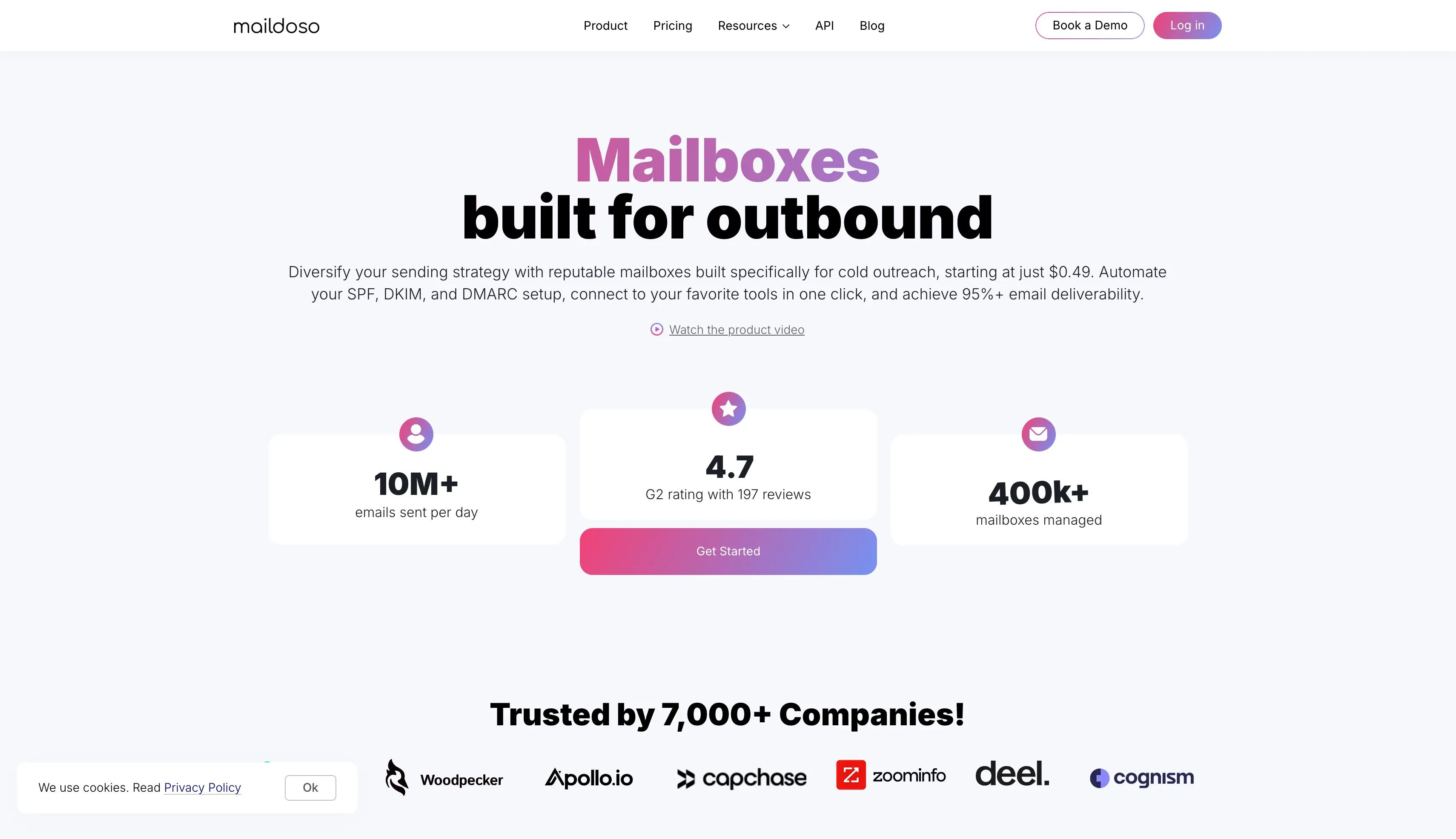
Compared with Inframail, Maildoso is the email infrastructure provider on this list that puts the most focus on mailbox-level monitoring and recovery. It runs inbox placement tests every three days and provides health scores for each mailbox. If a mailbox is flagged as underperforming, Maildoso pauses it for 14 days to protect its email reputation before returning it to rotation.
Maildoso also offers Google Workspace mailboxes, although its public pricing currently focuses on SMTP plans. For a direct comparison, see Maildoso vs Inframail.
Key features
Pricing
Maildoso pricing starts at $75/month for 30 SMTP mailboxes. The 300-mailbox plan costs $225/month, while the 1,000-mailbox plan costs $499/month. Monthly SMTP plans charge $12/year per domain, while quarterly plans include domains. You can also bring your own domain.
I break down every plan in my Maildoso pricing guide, and the Maildoso review covers how the self-healing rotation works in practice.
Best for: Teams that want Google Workspace or Microsoft 365 mailboxes with simple provisioning and automated setup.
Zapmail provides Google Workspace accounts and Microsoft 365 mailboxes for cold outreach. It handles mailbox creation, DNS setup, and domain management from one dashboard. You can also connect the mailboxes to your preferred outreach tools.

Compared with Inframail, Zapmail gives you access to both Google Workspace and Microsoft 365 mailboxes, rather than limiting you to Microsoft-backed accounts. That lets you match the inbox provider your prospects already use. It also provides workspace management, deliverability testing, and bulk mailbox customization.
Zapmail also offers pre-warmed mailboxes through separate plans. These are not included in the standard mailbox plans.
Key features
Pricing
Zapmail pricing starts at $39/month for 10 Google Workspace mailboxes. The Growth plan costs $99/month for 30 mailboxes, while the Pro plan costs $299/month for 100 mailboxes. Microsoft 365 and pre-warmed mailboxes are also available through separate plans.
My Zapmail review covers the renewal pricing and pre-warmed mailboxes and its infra in more detail.
As a conclusion, choosing the right Inframail alternative depends on the type of email infrastructure platform you need.
If you want dedicated infrastructure with dedicated IPs and more control, Infraforge is the better option. If you want shared infrastructure at a lower cost, Mailforge is the better choice.
Both options give you flexibility for cold email campaigns and keep email deliverability in your hands, so the right choice comes down to your infrastructure needs and budget.
Infraforge is the closest Inframail alternative if you want to keep dedicated IPs. It adds pre-warmed domains and mailboxes, multiple IPs per account, and no fixed cap on how many mailboxes you can create. If lower cost matters more than dedicated infrastructure, Mailforge is the better pick.
Inframail pricing starts at $129 per month for the Unlimited plan, which includes one dedicated US IP and unlimited inboxes. The Agency Pack costs $327 per month with three dedicated IPs. Annual billing is available at a discount, and domains are charged separately.
Infraforge is better if you want pre-warmed mailboxes, more than one or three dedicated IPs, or the option to manage infrastructure through MCP and CLI. Inframail is cheaper if you already run a large number of Microsoft inboxes and its flat fee works out lower than per-mailbox pricing at your volume.
Inframail sells Microsoft-backed inboxes on a dedicated IP for a flat monthly fee. Mailforge sells shared SMTP infrastructure at $3 per mailbox slot per month with a 10-slot minimum. Mailforge costs less for smaller setups and includes pre-warmed mailboxes at no extra charge, while Inframail's flat fee suits teams running a large number of inboxes.
No. Inframail only provides Microsoft-backed inboxes, so you cannot match a prospect whose mailbox provider is Google. If you need Google Workspace mailboxes, Zapmail offers them from $39 per month for 10 mailboxes, and Maildoso offers them alongside its SMTP plans.
Infraforge is the best fit for agencies that need client separation on dedicated IPs, workspaces, and a white-label option. Mailreef suits agencies that want a managed dedicated server with hands-on support. Mailforge works well for agencies onboarding clients at 10 to 30 mailboxes each, since per-slot pricing keeps each client's bill predictable.