

Mailscale sells cold email inboxes in three fixed tiers on shared IPs, with a 7-day trial. Maildoso sells SMTP and Google Workspace mailboxes, billed monthly or quarterly, with no free trial. Both run on shared infrastructure, and both carry documented deliverability complaints once campaigns pass the first few weeks.
For cold email infrastructure that scales without tier cliffs or quarterly lock-ins, Mailforge is the stronger choice. You pay per mailbox from $3 down to $2, set up in 5 minutes, get free Warmforge warm-up, and can upgrade single domains to dedicated IPs without switching tools.
I run cold email for agencies, and infrastructure is the line item that quietly eats margin. Pick wrong here and it costs you more than a bad sequencer or weak copy ever will.
This post compares three providers I have used: Mailscale, Maildoso, and Mailforge. All three sell cold email mailboxes at scale. They route deliverability risk in very different ways.
I have also sat through enough domain burns to tell the difference between a provider that warns you before reputation drops and one that hands you a .xyz domain after your .com gets flagged. That is the lens here.
Cold Email Infrastructure at a Glance: Mailscale vs Maildoso
| Feature | Mailforge | Mailscale | Maildoso |
|---|---|---|---|
| Infrastructure type | Distributed shared IP pool, built for cold email | Shared IP, owns its SMTP servers | Shared SMTP plus real Google Workspace |
| Entry price | $3 per mailbox/mo (pay per mailbox) | Solopreneur $79/mo (15 inboxes) | Monthly SMTP $75/mo (30 mailboxes) |
| Price near 200 mailboxes | ~$484/mo (~$2.42/mailbox) | Enterprise $249/mo, ~$199/mo annual (200 inboxes) | Monthly SMTP 300: $570/mo ($1.90/mailbox) |
| Pricing model | Flat per-mailbox, no tiers | Fixed tiers (15 / 50 / 200) | Volume tiers plus a quarterly option |
| Setup time | 5 minutes | 5 minutes | 15 minutes |
| Free trial | No (test 10 mailboxes for $30) | 7-day free trial | No (30-day money-back on quarterly) |
| DNS automation | SPF, DKIM, DMARC plus bulk DNS updates | SPF, DKIM, DMARC | SPF, DKIM, DMARC |
| Microsoft 365 mailboxes | Via Primeforge | No | No |
| Warm-up | Free Warmforge integration | Built-in warm-up | Built-in warm-up |
| Burn recovery | Mailbox slots plus Warmforge monitoring | 30-day domain recovery (excludes BYO) | Self-heal: pauses burned mailboxes 14 days |
| SOC 2 compliant | Yes | Not advertised | Not advertised |
| Best for | Agencies and high-volume senders on one stack | Teams that fit the 15/50/200 tiers | Teams wanting SMTP plus Google Workspace |
Mailscale Overview: Tiered Cold Email Inboxes

Mailscale is a cold email infrastructure provider that sells inboxes in fixed tiers. The pitch is fast inbox provisioning, automated DNS, and a deliverability guarantee. You pick a tier, buy or bring domains, generate inboxes as a CSV, and plug them into a sequencer like Instantly or Smartlead.
Core features
- Bulk inbox creation in under 60 seconds, exported as a CSV with login credentials
- Automated SPF, DKIM, and DMARC on every domain
- Built-in warm-up included on all paid plans
- A reply and deliverability guarantee on the higher tiers ("get more replies or you don't pay")
- Owns its full SMTP and IP infrastructure rather than reselling Google or Microsoft
- A bundled cold email course on the Business plan
- Works with Instantly, Smartlead, Apollo, Saleshandy, Lemlist, and similar tools
Mailscale pricing
Pricing from the live mailscale.ai homepage, monthly billing (annual knocks roughly 20% off):
- Mailscale Solopreneur: $79/mo monthly (~$63/mo annual) - up to 15 inboxes, ~2,000 prospects/month
- Mailscale Business: $119/mo monthly (~$95/mo annual) - up to 50 inboxes, ~10,000 prospects/month, cold email course included
- Mailscale Enterprise: $249/mo monthly ($199/mo annual) - up to 200 inboxes, ~30,000 prospects/month, extra inboxes at $1.50 each
- Mailscale Unlimited Mailboxes: $1,000+/mo - dedicated IPs, self-healing, a dedicated deliverability specialist (apply through a form)
Domains run $10-15/year inside Mailscale, or $2/domain to bring your own. Mailscale states plainly that it cannot guarantee deliverability on bring-your-own domains. The 7-day free trial covers all paid plans.
Who Mailscale is best for
Solo founders and small agencies whose inbox count fits inside a tier cap of 15, 50, or 200. The bundled course and the "we'll replace burned domains" guarantee read as built for first-time cold emailers more than seasoned operators. If you are mapping the wider category, Mailforge's roundup of mailbox automation tools covers where Mailscale sits.
What reviewers say
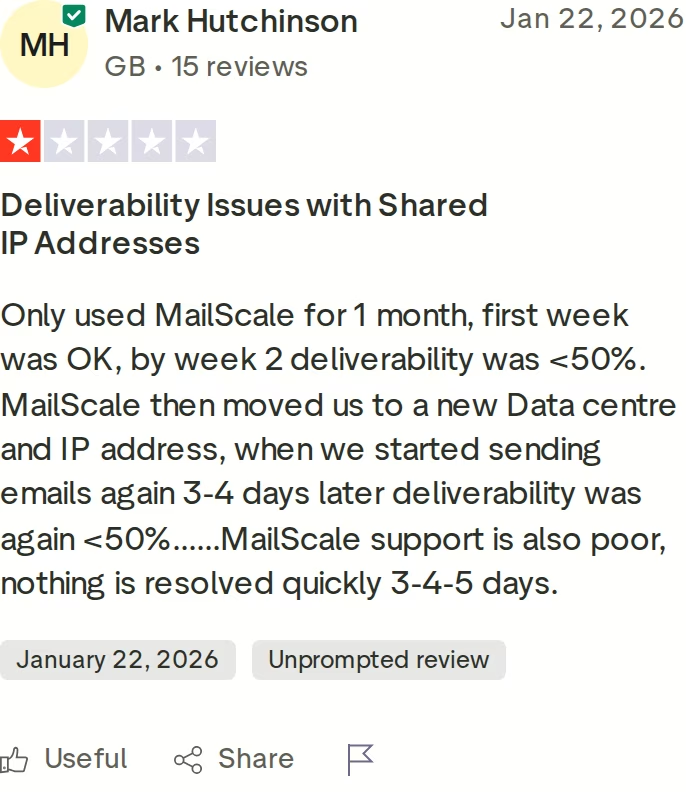
- Tier breakpoints create a growth tax. Need 16 inboxes? You jump from $79 to $119. Need 51? You jump to $249. That is a real penalty for one extra mailbox.
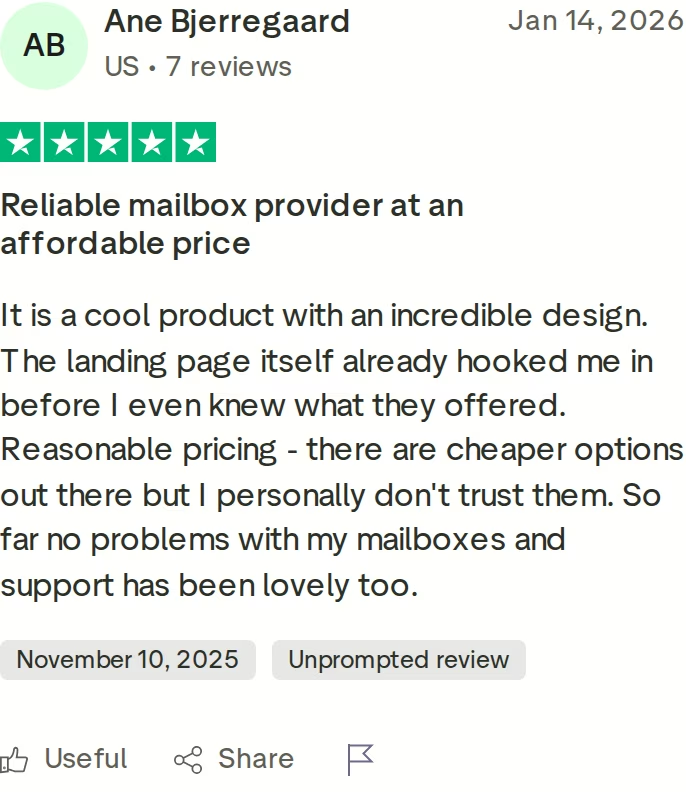
- Deliverability complaints cluster after week two. Mailscale holds a 4.1/5 Trustpilot score, with recent 1-star reports describing inbox placement falling under 50% by week two, IP-pool swaps that did not fix it, and slow support during incidents. The Mark Hutchinson review above is typical.
- The guarantee has carve-outs. It applies to professional Google and Microsoft inboxes and requires at least 80% placement to qualify for recovery. Bring-your-own domains are excluded.
- Cancellation friction shows up too. Several reviewers report the trial auto-renews and that canceling means contacting support, so set a reminder before the trial ends.
Maildoso Overview: SMTP and Google Workspace Mailboxes
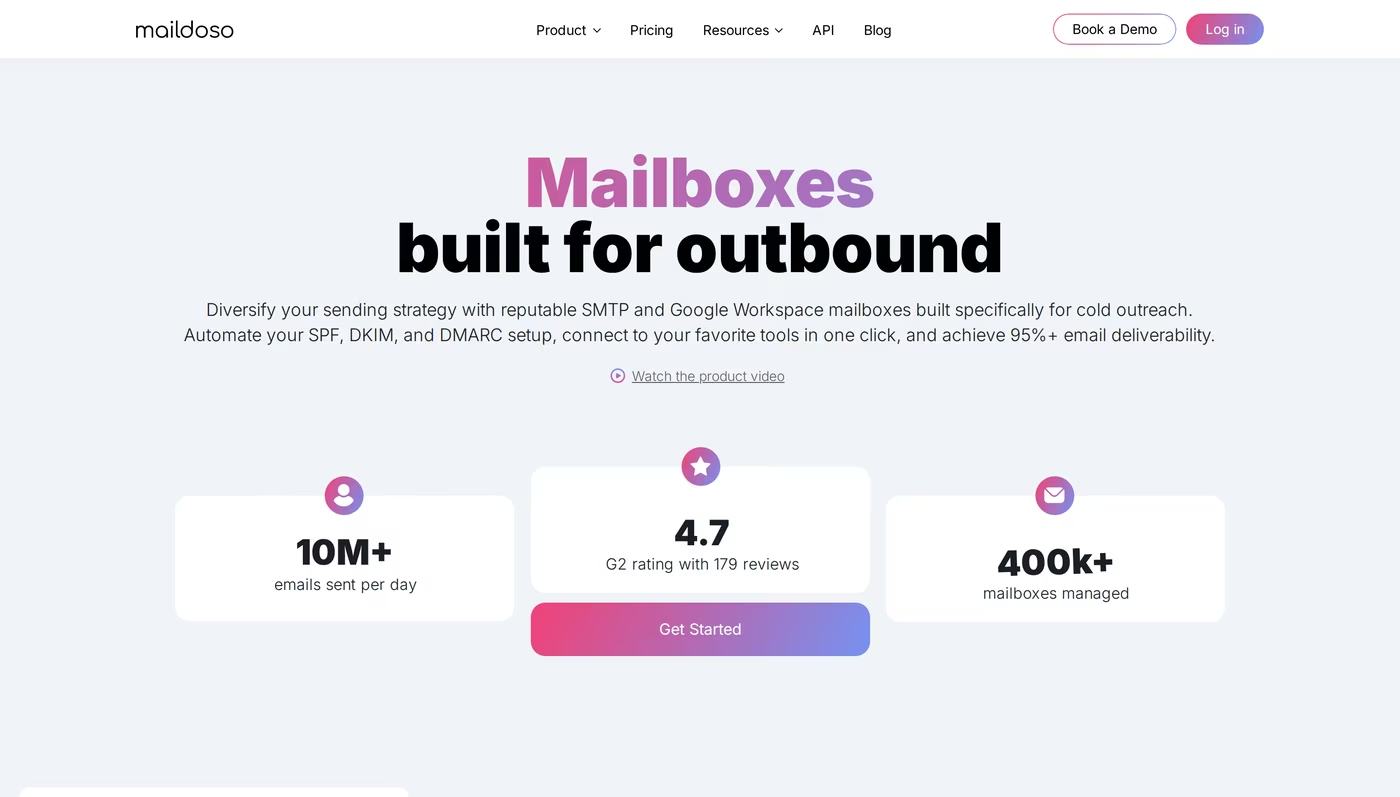
Maildoso is a cold email infrastructure provider selling SMTP mailboxes and real Google Workspace accounts. It positions itself as the budget Google Workspace alternative, and it is one of the few providers that lets you mix SMTP and Google Workspace mailboxes in one combo plan. The platform handles DNS, IP rotation, master inbox forwarding, and 3-day placement tests.
Core features
- SMTP-only, Google Workspace-only, or combo plans that mix both
- Automated SPF, DKIM, and DMARC configuration
- IP rotation across multiple data centers
- Self-healing mailboxes: burned mailboxes auto-pause for 14 days, then return to rotation
- Inbox placement tests every 3 days with per-mailbox health scores
- One isolated Google Workspace account per domain
- Send links in the first email without (in their claim) hurting deliverability
- Full API access for programmatic mailbox creation
Maildoso pricing
Pricing from the live maildoso.ai/pricing page, across three product lines:
- Monthly Combo (SMTP + Google Workspace): $90/mo (15+15, 6 domains), $175/mo (35+35, 14 domains), $675/mo (150+150, 60 domains)
- Monthly SMTP-only: $75/mo (30 mailboxes), $158/mo (70 mailboxes), $570/mo (300 mailboxes at $1.90 each)
- Quarterly SMTP (domains free): $299/qtr (32 mailboxes, 8 domains), $499/qtr (68 mailboxes, 17 domains), $2,199/qtr (400 mailboxes, 100 domains)
Domains are free on quarterly plans and supplied separately on monthly plans. There is no free trial, but quarterly plans carry a 30-day money-back guarantee.
Who Maildoso is best for
Teams that specifically want a mix of SMTP and Google Workspace mailboxes in one place, and operators comfortable paying quarterly upfront. The setup works for short experiments and for budget-conscious agencies whose campaigns do not burn domains aggressively. For a side-by-side on a similar pair of infrastructure tools, Mailforge has another infrastructure comparison worth reading.
Honest limitations
Maildoso has no Trustpilot page, and its main review site, G2 (4.7/5 on its own homepage badge), blocks automated capture, so here are the documented complaints from G2 and Reddit, paraphrased:
- Burned-domain replacements arrive as .xyz or .click TLDs. This is the loudest complaint across review aggregators. When a Maildoso .com gets flagged, replacements often come back on non-standard TLDs that hurt deliverability and credibility on cold outreach.
- Quarterly billing locks you in before you can test. The starter SMTP tier is $299 upfront. You do not get to validate deliverability on your own list before committing.
- Shared infrastructure quality varies. Independent tests cited by Puzzle Inbox put Maildoso SMTP around 85-90% inbox placement versus 92-95% on Google Workspace over a 3-month, 100-mailbox test. Reddit reports describe blocklisting incidents that paused campaigns.
- No Microsoft 365 option. If your ICP skews enterprise, you cannot run a Microsoft-tenant mailbox alongside the Google one to hedge ESP risk.
Mailforge Overview: Per-Mailbox Cold Email Infrastructure
Mailforge is the shared-IP cold email infrastructure layer in the Forge Stack. It provisions inboxes in 5 minutes, auto-configures DNS, and is built for high-volume cold outreach. It sits alongside Warmforge for warm-up and monitoring, Infraforge for private dedicated IPs, Primeforge for real Google and Microsoft mailboxes, and Salesforge for multi-channel outreach.
Core features
- Flat per-mailbox pricing: $3 down to $2 by volume, with no tier cliffs
- Setup in 5 minutes, including automated SPF, DKIM, and DMARC
- Bulk DNS updates from inside the app for multi-domain infrastructure
- Multiple workspaces, one per client or project
- Domain transfers in or out, so you own the domains
- SSL and domain masking available as add-ons
- Works with any sequencer, not locked to Salesforge
- Mailbox slots: pay for a slot and swap mailboxes in or out without changing the subscription
- SOC 2 compliant
- Whitelabel and reseller program with 20% revenue share
The Forge Stack context
Mailforge is one product, not an island. The same login gives you free Warmforge warm-up, an upgrade path to Infraforge dedicated IPs for specific domains, Primeforge for real Google Workspace or Microsoft 365 mailboxes, Leadsforge for a 500M+ contact database, and Salesforge as the outreach layer. If you would rather not stitch tools together, that matters. Mailforge also publishes a deep roundup of cold email infrastructure tools if you want the wider field.
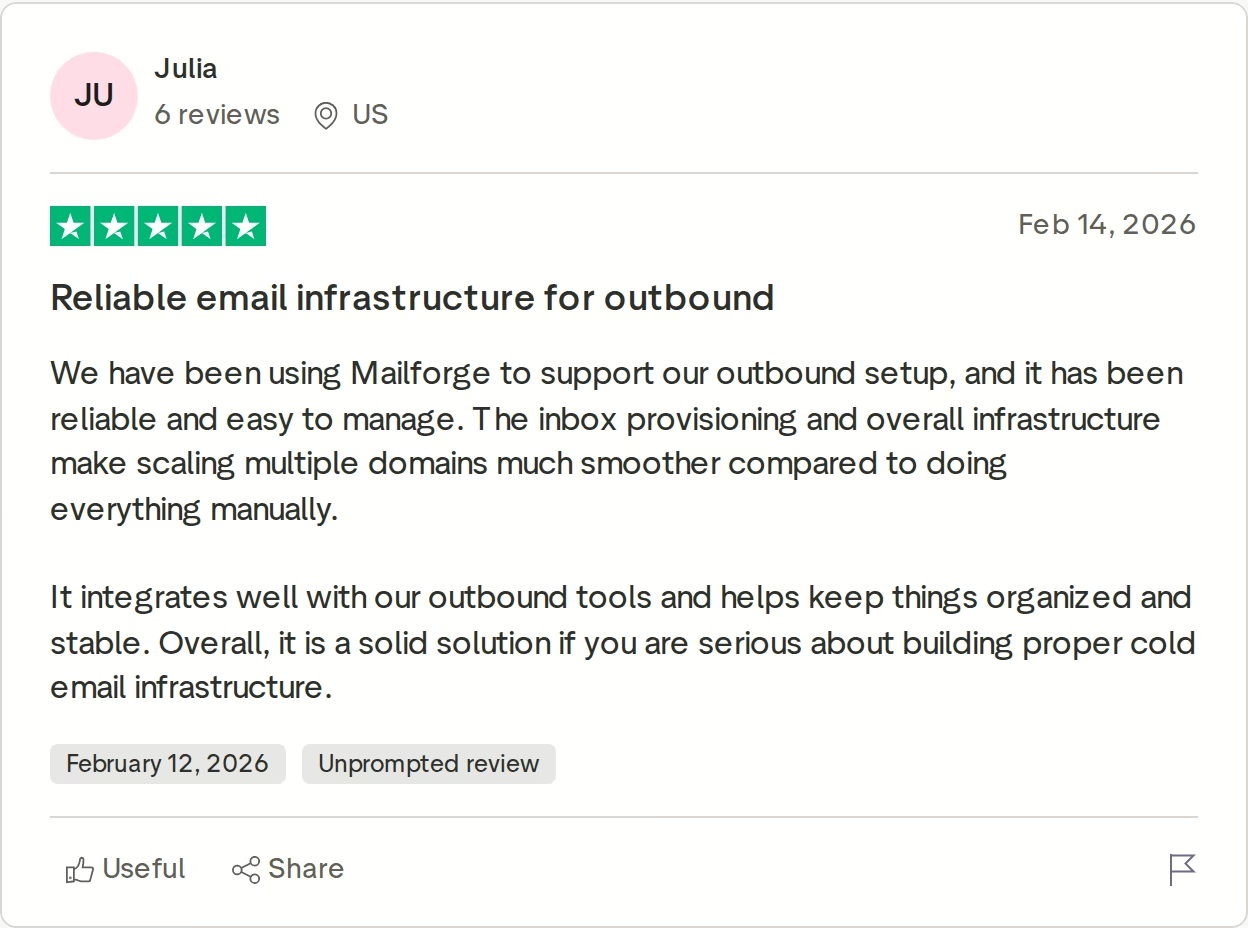
Mailforge pricing
- Per-mailbox rate: $3/mailbox/mo, dropping to $2/mailbox at higher volumes
- 200 mailboxes: ~$484/mo (~$2.42/mailbox) versus $1,680/mo for Google Workspace or $1,200/mo for Microsoft 365 direct
- Free Warmforge warm-up alongside the Forge Stack, plus continuous reputation monitoring
- Add-ons: SSL and domain masking, and 2x 1:1 expert sessions at $500 if you want consulting
Who Mailforge is best for
Mailforge fits B2B agencies and high-volume senders selling to startups, SMBs, and mid-market buyers - the kind of teams running 50+ mailboxes who want predictable per-mailbox economics. It is a clean fit if you already use or plan to use the wider Forge Stack. It is not built for a solo founder who needs 10-15 inboxes once and never plans to scale, where absolute dollars are lowest on a small fixed plan.
Honest limitations
- Shared IP pool. Mailforge runs distributed shared IPs, not dedicated. For single-tenant IPs you upgrade specific domains to Infraforge inside the same stack, but Mailforge alone is not dedicated infrastructure.
- No native Google Workspace or Microsoft 365 mailboxes. That is what Primeforge is for. For ESP-matched sending you pair Mailforge with Primeforge.
- No bundled guarantee. Warm-up and monitoring come from Warmforge, free alongside the stack but a separate workflow in the app.
A real benchmark: SalesCaptain, a Clay Enterprise Partner, moved the bulk of its cold email infrastructure to Mailforge to run outreach across 30+ clients. UniteSync reached an 85.26% positive reply rate and a $2.86 CAC on Salesforge, Mailforge, and Warmforge. Both are published with named customers.
Take Mailforge for a Spinin Action
Head-to-Head Feature Comparison: Mailscale vs Maildoso
Infrastructure model and IP strategy
All three run shared infrastructure at their entry tiers. Mailscale owns its SMTP and IP pools but routes every customer through them, so a reputation hit from a neighboring sender can ripple. Maildoso runs SMTP across multiple data centers with IP rotation as its headline differentiator. Mailforge runs a distributed shared IP pool tuned for cold email volume, and lets you upgrade single domains to dedicated IPs via Infraforge in the same dashboard. Mailforge has the cleanest exit when shared-IP risk becomes a problem.
Email deliverability and warm-up
Mailscale and Maildoso both bundle their own warm-up. Maildoso adds placement tests every 3 days, which is a genuine plus for spotting drops early. Mailforge keeps warm-up and monitoring in Warmforge, free alongside the stack, with a per-mailbox Heat Score and continuous reputation checks. The practical difference is prevention versus reaction: Warmforge flags a mailbox before it burns. If you want to compare monitoring options, Mailforge lists the leading inbox placement tools separately.
DNS automation and setup speed
All three automate SPF, DKIM, and DMARC. Mailscale and Mailforge both ship inboxes in 5 minutes; Maildoso advertises 15 minutes. Mailforge is the only one of the three with bulk DNS updates from inside the app, which matters once you run 50+ domains across workspaces. Mailforge is also the only SOC 2-compliant provider of the three, which matters for agencies serving enterprise clients.
Domain protection and burn recovery
This is the highest-stakes axis. Mailscale promises 95-100% placement and free domain replacement if a domain drops below 80% within 30 days, but the guarantee excludes bring-your-own domains and reviewers say recovery drags. Maildoso auto-pauses burned mailboxes for 14 days, and the .xyz or .click replacement pattern is its loudest complaint. Mailforge keeps spare mailboxes warming as replacements while Warmforge watches reputation, so you see decline before it becomes a burn. Mailscale and Maildoso react to burns; Mailforge plus Warmforge tries to prevent them.
Pricing model and scalability
This is where the three diverge most. Mailscale uses fixed-tier pricing with hard caps at 15, 50, and 200 inboxes, so jumping from $79 to $119 for one extra inbox is a real margin hit at scale. Maildoso uses volume-tiered pricing with three breakpoints per product line and free domains on quarterly plans. Mailforge uses flat per-mailbox pricing from $3 down to $2 with no tier cliffs. For an agency running 23 mailboxes this month and 87 next month, Mailforge is the only model that does not punish that variance.
Ecosystem and integrations
Mailscale and Maildoso both export to any major sequencer, which is table stakes. Mailforge does the same and slots natively into the Forge Stack: Salesforge for execution, Warmforge for warm-up, Infraforge for dedicated IP upgrades, Primeforge for real Google and Microsoft mailboxes, and Leadsforge for the 500M+ contact database. If you would rather not stitch tools together, Mailforge is the only one of the three that gives you that exit ramp. It also shows up across infrastructure roundups like the best Lemlist alternatives.
Pricing Comparison: What Each Provider Actually Costs
Headline pricing tells one story. Total cost over 12 months at a real send volume tells another. Here is a 50-mailbox and a 200-mailbox view, with domains amortized monthly.
| Scenario | Mailforge | Mailscale | Maildoso |
|---|---|---|---|
| 50 mailboxes | 50 x $3 = $150/mo | Mailscale Business $119/mo ($95/mo annual) | Monthly SMTP 70 (next tier): $158/mo |
| Annual cost (50) | ~$1,800/year | $1,428/year monthly, ~$1,140/year annual | ~$1,896/year plus domains |
| Domain cost | Bring your own or buy inside | $10-15/year each | Free on quarterly, supplied on monthly |
| 200 mailboxes | ~$484/mo (~$2.42/mailbox) | Mailscale Enterprise $249/mo ($199/mo annual) | Monthly SMTP 300 (overshoot): $570/mo |
| Annual cost (200) | ~$5,808/year | $2,988/year monthly, ~$2,388/year annual | ~$6,840/year |
Read this table carefully. At 200 mailboxes, Mailscale Enterprise looks dramatically cheaper, because it is a flat plan with extra inboxes at $1.50 each beyond the base 200. That advantage holds only if you fit inside the tier and the guarantee actually applies to your sending pattern.
Mailforge's ~$484/month at 200 mailboxes is real per-mailbox cost with no tier cliff or recovery clause. Send 300 one month and 180 the next, and Mailforge bills on actual usage while Mailscale bills on the higher tier. Maildoso wins on SMTP sticker price at 300+ mailboxes ($1.90 each) but loses on total cost once you factor in the domain-replacement pattern and the missing free trial. If you want the broader field, Mailforge ranks the best cold email service providers too.
Who Should Use Mailscale, Maildoso, or Mailforge?
You might consider Mailscale if:
- You want a 7-day free trial before you commit any money
- Your sending fits inside one of three tiers (15, 50, or 200 inboxes) and you do not expect to grow past it
- You are new to cold email and the bundled course on the Business plan is useful to you
You might consider Maildoso if:
- You specifically want both SMTP and real Google Workspace mailboxes from one provider
- You can commit quarterly upfront and the 30-day money-back window is enough safety
- Your campaigns are short experiments where a .xyz replacement domain would not kill credibility
Choose Mailforge if:
- You are an agency or high-volume sender running 50+ mailboxes and need predictable per-mailbox economics without tier cliffs
- You want SOC 2 compliance baked in - the only one of the three that publishes a badge
- You want a clean upgrade path to dedicated IPs (Infraforge) or real Google and Microsoft mailboxes (Primeforge) inside the same dashboard
- You want free Warmforge warm-up and monitoring alongside your infrastructure, not bundled warm-up of unknown pool quality
- You are a reseller or whitelabel partner and want 20% revenue share on every account you bring
Final Verdict: Which Cold Email Infrastructure to Choose
Mailscale and Maildoso are both functional cold email infrastructure providers. Mailscale's tier model rewards you for staying inside a fixed inbox count. Maildoso's SMTP-plus-Google-Workspace bundle is a real product difference. Both have documented complaints I would want a new operator to read before paying.
For cold email infrastructure that scales without tier penalties, quarterly lock-ins, or .xyz replacement domains, Mailforge is the stronger choice. Flat per-mailbox pricing from $3 down to $2, SOC 2 compliance, 5-minute setup with bulk DNS updates, and a clean upgrade path to dedicated IPs or real Google and Microsoft mailboxes, all inside one stack.
One falsifiable benchmark: LFG, a UK lead generation agency, used Mailforge and Warmforge to help its client Pepper reach £397,161 in closed revenue in 6 months on cold email. The case study is public, with named customers and specific numbers.
Frequently Asked Questions
Is Mailforge better than Mailscale?
For agencies and high-volume senders, Mailforge fits better on three measures: flat per-mailbox pricing avoids Mailscale's tier breakpoints, where moving from 15 to 16 inboxes jumps you from $79 to $119; SOC 2 compliance is published, while Mailscale's is not; and you can upgrade single domains to dedicated IPs through Infraforge in the same dashboard. Mailscale's 7-day free trial is its one clear edge if trial access matters most to you.
What is the main difference between Maildoso and Mailforge?
Maildoso bundles real Google Workspace mailboxes alongside SMTP, billed monthly or quarterly, and has a documented pattern of replacing burned domains with .xyz or .click TLDs. Mailforge sells per-mailbox SMTP-style infrastructure at $3 down to $2 on monthly billing with no quarterly lock-in. If you specifically need Google Workspace mailboxes, the Forge Stack equivalent is Primeforge, which Mailforge connects with natively.
Which is cheapest at 200 mailboxes?
On annual billing, Mailscale Enterprise has the lowest sticker price at roughly $199/month for up to 200 inboxes. Mailforge sits around $484/month at that volume, and Maildoso Monthly SMTP at the next tier costs $570/month for 300 mailboxes. The Mailscale figure only holds if your sending fits inside the 200-inbox cap and the deliverability guarantee applies. Mailforge bills per mailbox, so 150 inboxes one month costs less than 200.
Does Mailscale offer a free trial?
Yes. Mailscale offers a 7-day free trial on the Solopreneur, Business, and Enterprise plans. The Unlimited Mailboxes plan at $1,000+/month is sales-led with no trial. Several Trustpilot reviewers report the auto-renew at the end of the trial caught them off guard, so cancel manually before the trial ends if you are not continuing.
Can I switch from Maildoso to Mailforge easily?
Yes. Mailforge supports domain transfers in, so you keep ownership of your domains. You import existing domains, Mailforge auto-configures the DNS records, generates fresh mailboxes, and exports credentials to your sequencer. Plan a 14-day warm-up before launching campaigns on the new mailboxes through Warmforge, which is free and unlimited alongside the Forge Stack.
Which tool has better email deliverability?
All three run shared infrastructure at their entry tiers, so deliverability depends on warm-up discipline, list quality, and sending volume. Mailforge pairs with Warmforge for free warm-up and continuous reputation monitoring via the Heat Score, and lets you upgrade single domains to dedicated IPs with Infraforge. Mailscale owns its SMTP and IP pools with a built-in guarantee, and Maildoso rotates IPs across data centers. Independent reviewers report deliverability swings on all shared-IP setups.
Does Maildoso include domains in its plans?
Domains are included free on Maildoso's quarterly SMTP plans: 8 domains on the $299/quarter tier, 17 on the $499 tier, and 100 on the $2,199 tier. The monthly Combo plans require you to supply a set number of domains (6, 14, or 60), bought separately. Mailscale charges $10-15/year for domains bought inside the platform, or $2/domain to bring your own, with no deliverability guarantee on bring-your-own domains.
What kind of infrastructure does Mailforge use?
Mailforge uses a distributed shared IP pool purpose-built for cold email volume patterns. SPF, DKIM, and DMARC are automated on every domain, bulk DNS updates are managed inside the app, and the infrastructure is SOC 2 compliant. If you need dedicated IPs, you upgrade specific domains to Infraforge at $4 down to $3 per mailbox. If you need real Google Workspace or Microsoft 365 mailboxes, you pair Mailforge with Primeforge at $4.50 down to $3.50 per mailbox.