If you're in sales, you already know the job isn't just about closing deals.
A big part of it is finding the right prospects, getting your emails into the primary inbox, following up consistently, and somehow keeping up with conversations happening across email, LinkedIn, and other channels.
And let's be honest, you can't do all of that efficiently without the right outbound sales tools.
That's why choosing the right outbound sales software matters. The right tool can save you hours, help you reach more prospects, and make your entire sales process a lot easier.
I went through a ton of outbound sales tools to find what I think are the best options in 2026.
Here's what I found.
Each of these outbound platforms earned its spot for a specific reason.
I'll cover what each tool gives you, where it falls short, and what real users say about it.
The first outbound sales tool on my list is Salesforge.
It's an all-in-one outbound stack without per-seat pricing that covers email sequences, LinkedIn automation, AI personalization, warmup, infrastructure, lead sourcing, and reply management under one login.
What stood out to me is the multichannel sequencer.
Email and LinkedIn run from the same campaign with conditional branching. If a prospect doesn't engage with your email, the sequence moves to a LinkedIn connection request or profile visit automatically.
And Salesforge doesn't charge extra for it. LinkedIn automation comes included with the plan. No second subscription, no separate add-on.
Agent Frank is the AI SDR, and he's genuinely interesting. He finds prospects based on your ICP, writes personalized emails in 21+ languages using prospect-level context pulled from websites, LinkedIn profiles, and blog posts. He sends sequences, follows up, and handles basic replies on his own.
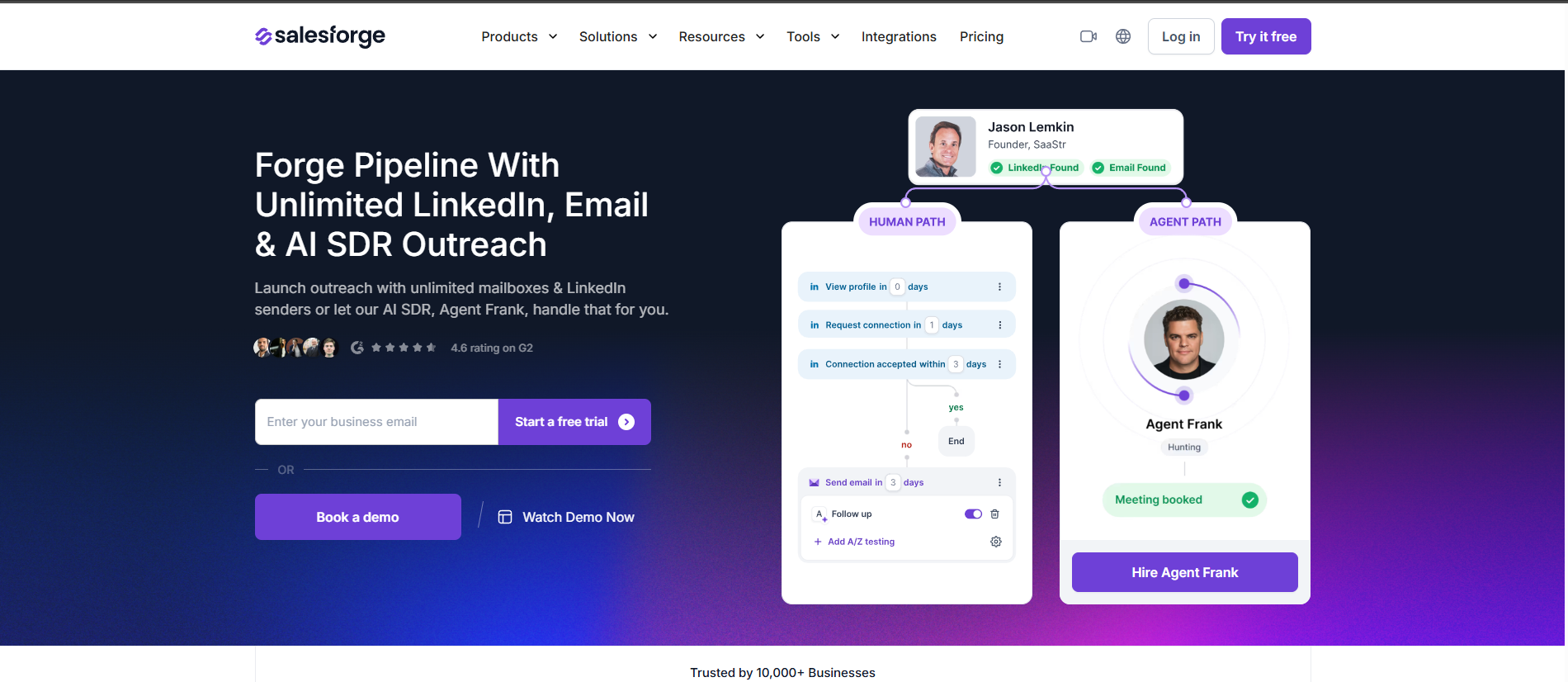
You choose Auto-Pilot (fully autonomous) or Co-Pilot (you approve before he sends). He comes with a dedicated account manager for setup and optimization. At ~$499/mo, he costs a fraction of what 11x.ai or Artisan charge for similar capabilities.
Unsurprisingly, getting him to produce quality output took some tuning upfront. But once I dialed in the ICP criteria and uploaded context to the Knowledge Base, the emails actually referenced my product correctly.
The full Forge Stack is what separates Salesforge from everything else on this list. Warmup runs through Warmforge on a private pool, included free on every plan.
For cold email infrastructure, you pick between Mailforge for shared IPs at $2-3/mailbox, Infraforge for dedicated IPs, or Primeforge for real Google Workspace and Microsoft 365 mailboxes.
Lead sourcing runs through Leadsforge with a 500M+ contact database, waterfall enrichment, and buying signals. Primebox pulls every reply from email and LinkedIn into one inbox with sentiment analysis.
Every plan includes unlimited mailboxes. A/Z testing goes beyond basic A/B variants. Mailbox rotation and dynamic IPs run in the background.
"Salesforge scales outbound effortlessly with unlimited email and LinkedIn senders." — Jacqueline L.
Another outbound sales tool on my list is Apollo.io.
It's an all-in-one outbound platform that bundles a 275M+ contact database, email sequencing, a built-in dialer, waterfall enrichment, intent data, AI lead scoring, and a lightweight CRM under one login.
I particularly enjoyed the search filters. Firmographic, technographic, funding stage, job changes, intent signals. Building a targeted prospect list that used to take me half a day took about 20 minutes in Apollo.
The Chrome extension pulls contact data straight from LinkedIn without leaving the page, and I found it reliable in day-to-day use. For a solo founder who doesn't want to manage five separate tools, Apollo removes that overhead entirely.
The free plan is genuinely usable, which is rare. You get database access, two active sequences, and 900 credits per year. Enough to validate whether cold outreach works for your offer before spending anything.
From my experience, though, the data quality problem shows up fast. I pulled a list of contacts and the bounce rate was noticeably higher than what I'm used to from verified sources. This isn't just my experience.
Across 9,671 G2 reviews, data accuracy is the most common complaint. Users consistently report 10-15% bounce rates on raw Apollo data. In r/SaaS, one user estimated only about 65% of contacts were usable in their test.
The per-seat pricing is the other thing worth flagging. On paper, $49/seat/mo for Basic sounds reasonable. But a team of four on Professional ($79/seat) plus the dialer add-on ($119/team) climbs past $435/mo quickly. Credits get consumed fast when phone numbers cost 8 credits each.
What Apollo does better than anyone else on this list is the "everything in one login" experience. The trade-off is that no single part of the platform is best-in-class. The data is good but not great.
The sequencer works but lacks the deliverability depth of dedicated cold email tools. The dialer exists but isn't as powerful as Klenty's parallel dialer. Still, the combination at this price point is hard to beat for someone getting started with outbound.
"Powerhouse lead generation with deep filtering and reliable automation." — Al W., Senior Salesforce Admin
The next outbound sales platform on my list is ZoomInfo.
It's the most well-known B2B sales intelligence platform out there, and also the most expensive tool on this list by a wide margin.
As an enterprise sales intelligence platform, ZoomInfo (now branded GTM Workspace) sits in a different category than the other seven tools here.
It's not a sending tool. It's a data layer built around 320M+ contacts and 100M+ companies, with real-time intent monitoring, CRM enrichment, conversation intelligence through Chorus, and account-based marketing workflows.
I can safely say that ZoomInfo's U.S. direct dial and mobile number accuracy is among the best available. If your SDR team does heavy phone outreach into U.S. enterprise accounts, this is the one advantage that Apollo and Saleshandy can't match at the same depth.
The Copilot AI features are genuinely useful at enterprise scale. AI-generated account summaries, buying group identification, champion tracking when contacts change jobs, and Streaming Intent that monitors which companies are researching your product category right now.
These capabilities don't exist in any volume-sending tool on this list.
The pricing is what bugs me the most, though.
ZoomInfo doesn't publish pricing publicly.
Based on what users report across Reddit and verified review sites, Professional starts around $14,995-$18,000/year for 1-3 seats. Advanced runs $22,000-$28,000/year.
Enterprise contracts hit $30,000-$60,000+.
One Redditor in r/DigitalMarketing reported a $36,000 renewal for 3 seats. Multiple threads describe aggressive auto-renewal practices and difficulty cancelling.
Data accuracy also drops significantly on smaller accounts. ZoomInfo is built for enterprise prospecting. For SMB and mid-market contacts, the data goes stale faster and the cost-per-useful-contact math falls apart quickly.
For SMB teams that want comparable data depth without a five-figure annual contract, pairing a tool with 500M+ contacts and waterfall enrichment alongside proper cold email infrastructure gets you a competitive prospecting stack at a fraction of ZoomInfo's cost.
Custom (contact sales for a quote)
"Fast, accurate data and strong ROI for channel prospecting." — Lannie L., Director of Channel Operations
The first time I saw a Lemlist email land in my inbox with a personalized screenshot of my own website embedded in the body, I stopped and actually read it. That's rare for cold email.
Lemlist is a personalization-first outbound platform that pioneered dynamic image and video personalization in cold email. Custom screenshots with the prospect's name, company logos embedded in visuals, personalized LinkedIn voice notes. No other tool on this list goes as deep on making cold messages feel warm.
But Lemlist has evolved well past its "fancy images" origin. In 2026, it's a full multichannel outreach platform with email, LinkedIn, calls (VoIP), WhatsApp, and SMS in a single campaign builder.
The sequence builder uses conditional branching based on prospect behavior. Combined with Liquid Syntax for conditional text and lemAgent's AI research, you can build sequences that feel individually crafted at scale.
From my experience, the multichannel builder is the most complete I've tested. Running email, LinkedIn connection requests, profile visits, and calls from one campaign with branching logic is genuinely well built.
The 650M+ database and 20,000+ intent signal types add a timing layer that I found useful. Intent signals include company website visits, hiring changes, fundraising rounds, and LinkedIn engagement. Each signal can trigger outreach at the moment a prospect shows buying readiness. That's a capability usually reserved for ZoomInfo-level pricing.
What I didn't like was the cost at scale. Lemlist's Multichannel plan runs $87/user/mo on annual billing.
A team of four pays $348/mo before credits. And credits for phone numbers ($0.20 each), company visit signals ($0.20), and LinkedIn engagement signals ($4.00+) add up fast. One G2 reviewer flagged the cost per lead as quite expensive compared to other outbound tools on the market.
lemwarm is included on all plans for warmup, and it's been running longer than most competitor warmup features.
But some users on Reddit and G2 reported declining domain reputation and frustration with deliverability at higher volumes. For teams sending at scale, the cold email service provider underneath matters as much as the tool on top.
Still, I'll let you decide whether the personalization depth justifies Lemlist's per-user pricing. For teams where reply rate matters more than send volume, Lemlist does something no other tool on this list can replicate.
"A powerhouse for 1:1 outreach and securing major partnerships." — Mansa L., Founder
Up next on my list of outbound sales tools is Instantly.
Ask any cold email community on Reddit which tool to start with, and you'll hear "Instantly" within the first three replies. Not because it does the most. Because it does the one thing it focuses on better than almost anyone: getting cold emails into inboxes.
Instantly is a cold email tool built around one promise: unlimited email accounts, unlimited warmup, and a clean interface that gets you from signup to first campaign faster than anything else in the category.
I found the setup quick and painless. No DNS headaches, no confusing onboarding flow. Connect your mailboxes, import your list, write your sequence, send. That simplicity is why agencies between 2022 and 2025 made it their default.
The Unibox is worth calling out. All replies from all campaigns land in one centralized inbox with AI categorization.
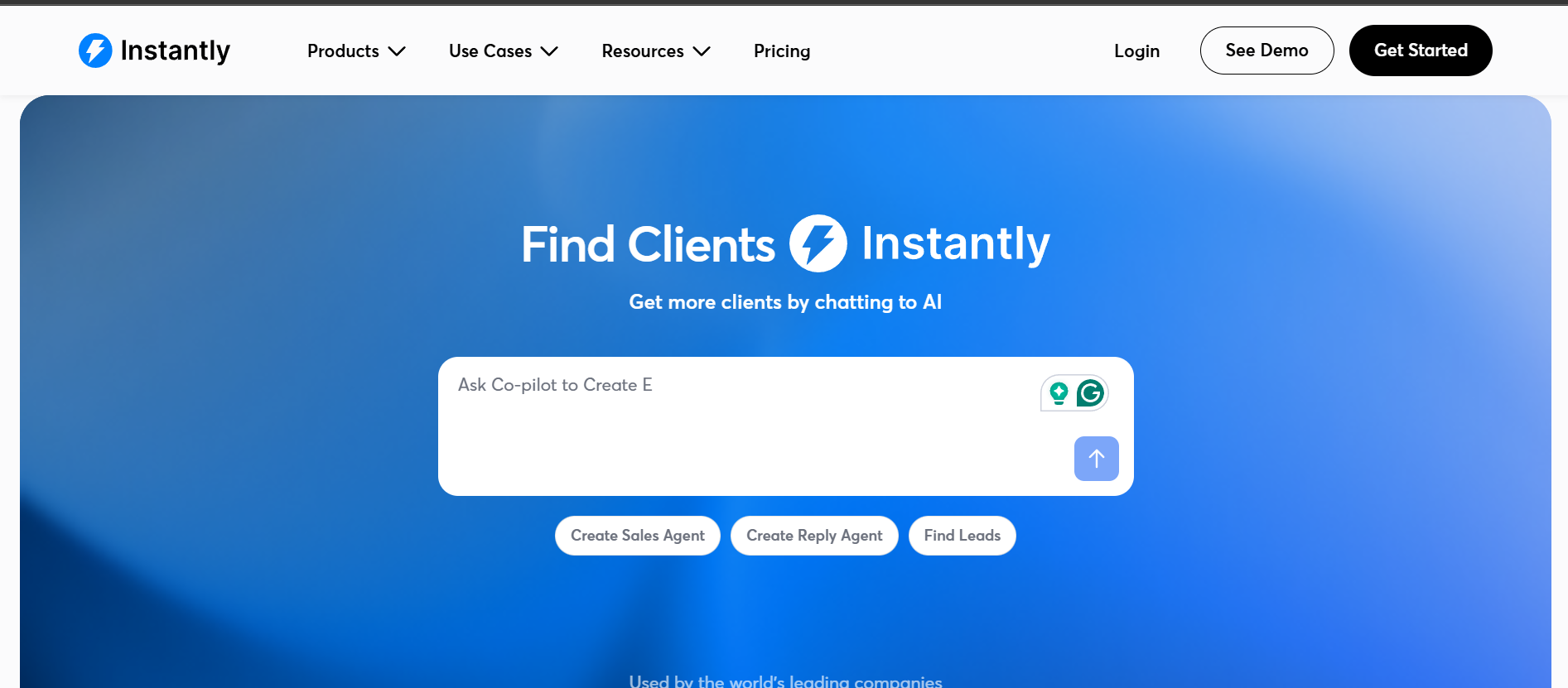
For teams managing high-volume responses across dozens of domains, it saves real time. The SISR system (Sending Infrastructure Spam Reduction) on Light Speed and above uses dedicated IP rotation to protect sender reputation, which is a meaningful upgrade from the shared warmup pool on lower plans.
What I didn't like was the pricing math once I looked past the headline.
The Growth plan at $47/mo includes only 5,000 emails/month and 1,000 uploaded contacts. For any real campaign, that's not enough.
You need Hypergrowth at $97/mo minimum. And the lead database is a completely separate subscription. Multiple review sites have pointed out that the real starting cost is closer to $144/mo when you combine outreach and leads.
The deliverability story also gets complicated at scale. Instantly uses a shared warmup pool on lower plans, and Reddit users consistently report 30-40% open rate drops when relying on shared warmed accounts. One r/coldemail thread mentioned deliverability dropping significantly after switching to Instantly's shared accounts.
The biggest limitation, though, is channel coverage. Instantly is email only. No LinkedIn automation, no dialer, no SMS. If your outbound motion involves anything beyond email, you're adding a second tool.
"Great for organizing outbound, but not without friction." — Konstantīns S., CEO/Founder
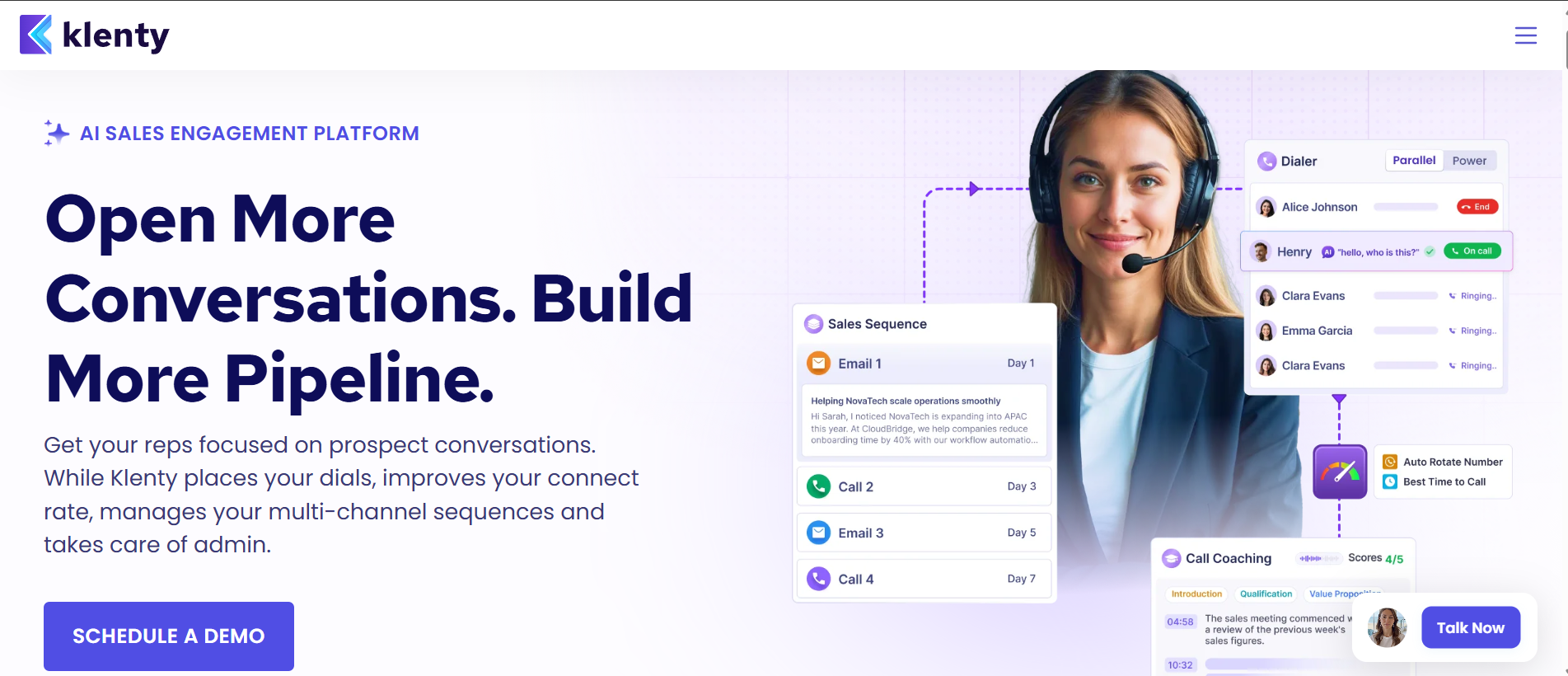
Another outbound sales platform on my list is Klenty, and it fills a gap none of the other seven tools here address well.
If your SDR team lives inside a CRM and you need your outbound stack to sync with Salesforce or HubSpot the way Outreach or Salesloft does, but without the enterprise price tag, Klenty is built exactly for that.
Klenty is a sales engagement platform positioned between the volume email senders (Instantly, Smartlead) and the enterprise platforms (Outreach, Salesloft). Its defining strength is the deepest CRM bidirectional integration I've tested on this list.
Salesforce, HubSpot, Pipedrive, Zoho, and Microsoft Dynamics all sync two ways. CRM updates propagate back to Klenty and vice versa, with auto-import triggers and sales stage automation. This isn't a one-way data dump. It's a real two-way connection.
The parallel dialer is the other feature I spent the most time with.
It pushes up to 350 calls per hour with AI voicemail detection, live transcription, AI call summaries, and coaching scorecards that grade calls against your talk track. The dialer add-on runs $45/seat/mo, which is substantially cheaper than standalone dialers like Orum or Nooks.
Unsurprisingly, the per-seat pricing is where Klenty's value gets tested.
Four reps on Plus ($99/user/mo) plus the dialer ($45 per rep) totals $576/mo. That's real money. But in comparison with Outreach or Salesloft, you're still paying significantly less for similar depth.
One G2 reviewer put it this way: "In comparison with the market, whether it be Salesloft or Outreach, you are priced well enough that it is a simple decision."
The biggest gap is that Klenty doesn't have a built-in contact database on Starter or Growth plans. The Plus plan includes 4,000 data credits per user, but for prospecting-heavy teams, you'll need Apollo, ZoomInfo, or your own list. Klenty is a "bring your own leads" tool at base pricing.
Still, for teams that care more about CRM hygiene, rep coaching, and structured sales playbooks than raw email volume, Klenty fills a specific need that Instantly, Smartlead, and even Salesforge don't prioritize in the same way.
"Klenty makes scaling cold outreach easy with strong sequencing and integrations." — Andrius N., VP of Sales
The next AI outbound software on my list is Smartlead.
I nearly wrote it off after spending ten minutes in the interface. It isn't pretty, TBH. But once I got past the UI, the infrastructure underneath is genuinely built for agencies that send at serious volume.
Smartlead, as a cold email infrastructure platform, directly competes with Instantly for the high-volume sender and agency market. The core technical advantage is SmartInfra, a dedicated-tenant IP infrastructure that isolates your sender reputation from other users on the platform.
On Instantly, you share a warmup pool with thousands of other senders. On Smartlead, your sending reputation is your own. For agencies managing 10+ clients, that isolation makes a measurable difference to deliverability.
White-labeling is built into the Smart and Prime plans at no extra fee. You present Smartlead as your own branded tool to clients, with custom sub-domains and client-specific workspaces.
The Master Inbox with AI reply classification lets you manage thousands of replies across all clients from one view. The AI automatically categorizes by intent: interested, not interested, meeting booked, objection.
I found this genuinely useful when managing multiple campaigns. Without it, reply triage across 10+ client accounts becomes a full-time job.
The API quality is worth calling out specifically. Developers and technical operators consistently praise it. One G2 reviewer described managing 7,767+ inboxes and 1.5M cold emails per month through Smartlead's API. If you're building custom automations with webhooks, Smartlead's technical layer is more flexible than Instantly's.
What I didn't like was the reliability. Product glitches show up in G2 reviews and Reddit threads consistently. Campaign management at scale (4,000+ campaigns) suffers from weak filtering, sorting, and bulk action tools.
"Effective for lead gen, but UX needs work." — Phil S., Co-founder
Recommended Read: Smartlead Alternatives
The last outbound sales tool on my list is Saleshandy.
It’'s a full outbound sales platform with an 852M+ contact database, multichannel sequences, a dialer, and white-label agency mode. The transformation happened quietly, and most people haven't caught up yet.
Saleshandy, as a budget-friendly AI outbound software, does something most competitors on this list refuse to do. It charges flat-rate regardless of team size. A team of two pays the same as a team of eight.
Starting at $25/mo with unlimited email accounts and warmup included, it's the cheapest real entry point here.
The Lead Finder database claims 852M+ contacts with 50+ buying signals. That would make it the largest of any tool on this list. I should be honest, though. Database size claims are hard to verify independently, and accuracy varies by industry. Some contacts I pulled were solid. Others felt outdated.
That's a trade-off you accept at this price point.
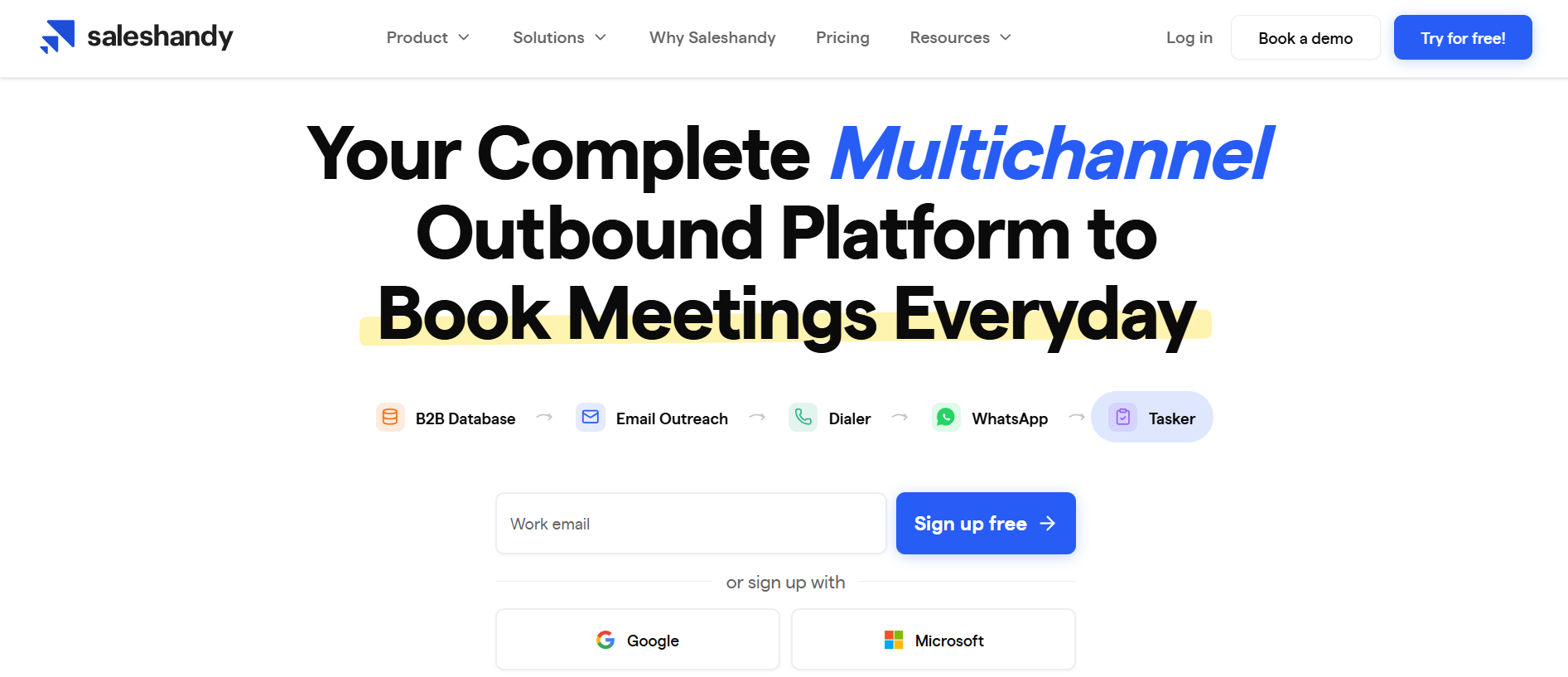
What I did like was the multichannel sequence builder. You can run email, LinkedIn, WhatsApp, calls, and manual tasks in one conditional sequence. If a prospect ignores your email, the sequence tries LinkedIn next. That branching logic is only matched by Lemlist on this list.
What I didn't like was the CRM depth. The native CRM is basic, and deep two-way Salesforce or HubSpot sync isn't where it needs to be yet. If your team lives inside a CRM, Klenty or Apollo will serve you better on that front.
The warmup quality also gets mixed reviews. Some users in r/coldemail switched tools specifically because of deliverability issues with the warmup network.
Agencies get white-label mode on the Scale plan ($139/mo), which lets you run unlimited client campaigns from one account with branded dashboards.
"Powerful, flexible platform for scalable, personalised outreach." — William W., Business Development Manager
After testing all eight outbound sales platforms, my pick is Salesforge.
It's the only tool on this list where I can run email and LinkedIn from the same sequence, plug in an AI SDR, connect three infrastructure options, get free warmup on a private pool, and add my fifth rep without paying a dollar more.
Every other tool forces a trade-off: Apollo charges per seat, Instantly is email-only, ZoomInfo costs more than most teams' entire stack, Smartlead has no LinkedIn, and Lemlist's per-user pricing compounds fast.
For B2B teams selling into startups, SMBs, or mid-market companies, Salesforge covers more of the outbound workflow under one roof than anything else available right now.
For small teams of 3-5 reps, Salesforge and Saleshandy offer the best value because both use flat-rate pricing. Your bill stays the same whether you have two reps or ten. Salesforge includes unlimited email and LinkedIn senders for $80/mo (annual).
Saleshandy starts at $25/mo with unlimited email accounts. Per-seat tools like Apollo ($79/seat), Klenty ($50-99/seat), and Lemlist ($55-87/seat) get expensive fast when you add a third or fourth rep.
Agent Frank costs ~$499/mo and handles prospecting, email writing, follow-ups, and basic reply handling autonomously. Compared to hiring a junior SDR ($4,000-6,000/mo fully loaded) or using enterprise AI SDR platforms like 11x.ai ($3,000+/mo), the cost is a fraction.
The key is upfront ICP tuning. Agent Frank's output quality depends directly on how well you define your ideal customer profile and upload relevant context to his Knowledge Base.
Shared IPs distribute your sending across IPs shared with other users. If another sender on the same IP gets flagged for spam, your deliverability takes the hit too, even if your emails are clean. Dedicated IPs give you full control over your sender reputation.
For high-volume senders or agencies managing multiple clients, dedicated IPs offer more predictable deliverability. Mailforge uses shared IPs. Infraforge uses dedicated IPs. Smartlead's SmartInfra uses dedicated-tenant infrastructure. Instantly's lower plans use shared warmup pools. For a deeper breakdown, this guide to cold email infrastructure tools covers the trade-offs.
Apollo's 275M+ database is the most accessible on this list thanks to the free plan and low entry pricing. But data accuracy is the most consistent complaint across G2 and Reddit. Users report 10-15% bounce rates on raw Apollo data.
The common recommendation from experienced outbound teams is to use Apollo for list building and run the data through a verification tool before sending. Pairing Apollo's data with a dedicated cold email service provider for sending keeps your deliverability separate from your data source.
Yes, and many experienced teams do. The most common stack on Reddit is a data tool (Apollo or ZoomInfo) for prospecting, a sending tool (Instantly, Smartlead, or Salesforge) for outreach, and a dedicated infrastructure provider like Mailforge for domains and mailboxes at $2-3/mailbox. This separation gives you better deliverability control and prevents your data provider's sending limitations from bottlenecking your campaigns.
Costs vary widely by tool choice and pricing model. For a team of four on annual billing: Salesforge Growth ($80/mo flat) + Mailforge infrastructure (~$100/mo) = ~$180-250/mo total. Apollo Professional ($79/seat x 4 = $316/mo) + dialer add-on = ~$435-600/mo. Lemlist Multichannel ($87/seat x 4 = $348/mo) + credits = ~$400-600/mo. ZoomInfo Advanced = ~$1,833-2,333/mo. The flat-rate tools (Salesforge, Saleshandy, Smartlead) keep costs predictable as you grow. Per-seat tools (Apollo, Klenty, Lemlist) scale linearly with headcount.
Apollo.io's free plan is the most feature-complete free option available. You get access to the full 275M+ database, basic search filters, two active sequences, and 900 credits per year. Enough to test whether outbound works for your offer.
Salesforge offers a 14-day free trial with no credit card required. Saleshandy offers a 7-day free trial. Smartlead and Lemlist both offer free trials as well. Instantly does not offer a free trial but has a demo available.
This is the most debated comparison in the cold email community. Smartlead wins on multi-client management (white-label, sub-accounts), dedicated IP infrastructure (SmartInfra), API depth, and webhook flexibility. Instantly wins on UI simplicity, faster setup, and ease of use.
Most agency operators on Reddit recommend Smartlead if you manage 10+ clients and care about deliverability isolation. Instantly if you want the simplest possible sending experience and manage fewer accounts.