Cheapinboxes is a low-cost mailbox provider that sells Google Workspace and Microsoft accounts for cold outreach at $2.80 to $3.50 per mailbox depending on how many you buy.
But if you are looking for a Cheapinboxes alternative, I do not blame you. This is not about the pricing being too aggressive. It is about picking infrastructure whose reality actually matches its marketing. When "pre-warmed" turns out to mean you still need a warmup tool, or "automated DNS" ships with broken DMARC records, the cheap sticker stops feeling cheap.
So I dug into the six alternatives that come up most often on cold email shortlists and compared them across pricing, deliverability, DNS reliability, warmup handling, and how well they scale past 30 mailboxes. You will see where each one fits, where each one falls short, and how to pick the right one for your setup.
Let's dive in.
Before I get into the six alternatives, it helps to understand what actually pushes teams to switch. I have not run 30 mailboxes on Cheapinboxes myself, but I read every third-party comparison, Trustpilot review, and cold email community thread I could find to see what the pattern looked like. Here is what kept coming up.
The pre-warmed promise does not match reported reality. Cheapinboxes markets mailboxes as pre-warmed and ready to send from day one, but multiple independent reviews report you still need a separate warmup tool. When ongoing warmup is not bundled, your total cost quietly goes up.
The automated DNS setup ships with fixable issues more often than the marketing suggests. One review reports roughly 20% of inboxes arrived with broken DMARC records. If you are buying to skip DNS work, this is exactly the pain you were trying to avoid.
Deliverability at real sending volume is inconsistent. Third-party reviews estimate inbox placement in the 58 to 68% range, with spam placement around 8 to 14%. These are not numbers I can independently verify, but the pattern shows up across sources.
There is no bundled deliverability monitoring or blacklist alerting. Once mailboxes go live, there is no built-in placement testing or reputation dashboard, so you have to source that separately.
Cheapinboxes has no public team page or SOC 2 attestation. For a service handling your sender reputation at scale, that opacity is a real trust gap that procurement teams flag quickly.
And once you scale past roughly 30 inboxes, the bulk management tooling does not keep up. That is when most teams start shopping for alternatives. For the full teardown on Cheapinboxes as a standalone product, my Cheapinboxes deliverability review breaks down what 30 mailboxes actually looked like in testing.
Now let's get into the six alternatives worth considering.
The number one Cheapinboxes alternative on my list is Mailforge. If your problem with Cheapinboxes is that the "minutes not days" claim fell apart on your first setup, Mailforge is the one where the promise actually holds.
I have set up cold email infrastructure across most of the tools in this comparison, and Mailforge is the one where I saw 100 mailboxes go live in under 10 minutes on a fresh account.
Mailforge is distributed shared-IP infrastructure built specifically for cold outreach at scale. It sells in 10-mailbox slot increments starting at $30 per month on annual billing, with domain provisioning, DNS setup, and mailbox creation all running in one flow.
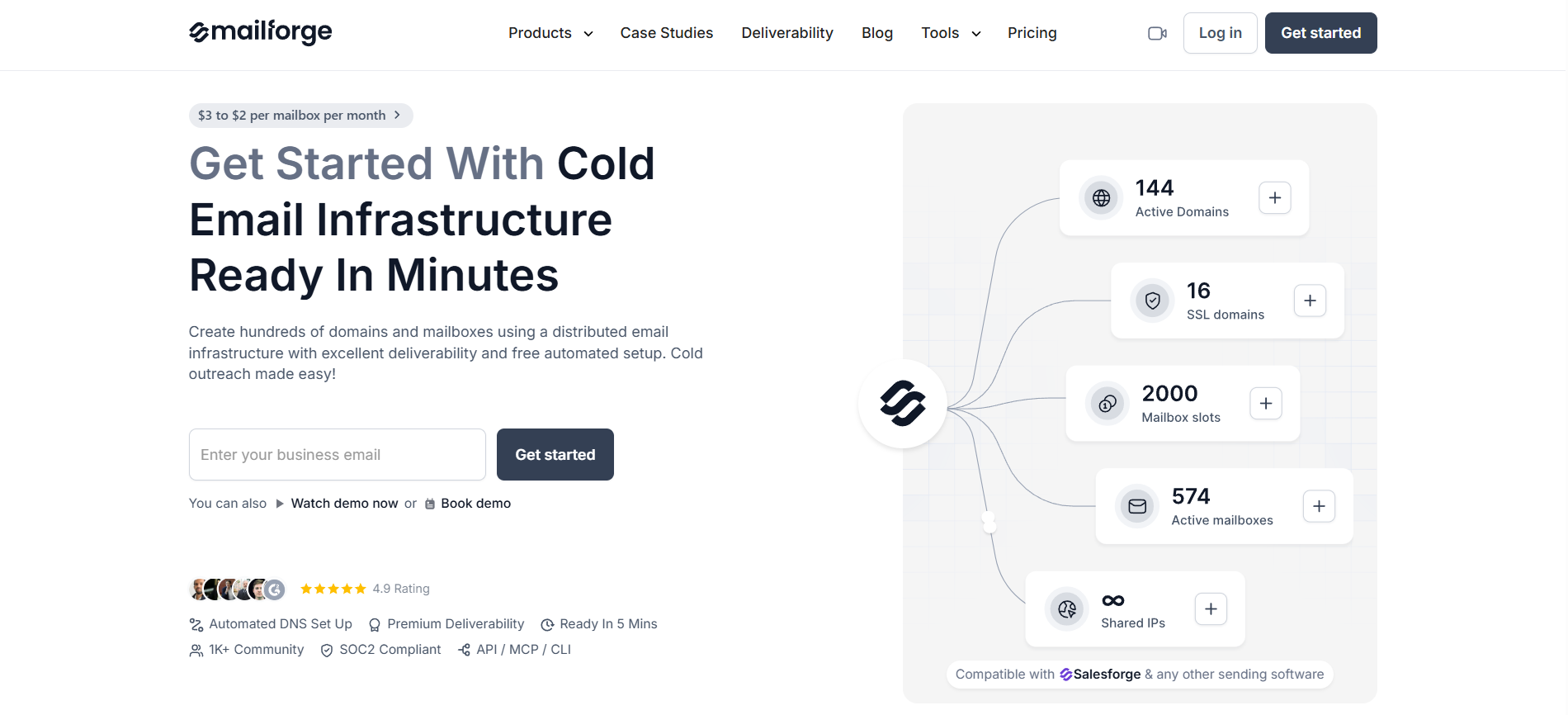
The same login also gets you free Warmforge warmup, which fills the exact gap Cheapinboxes users complain about, and if you outgrow shared IPs later, you can move to dedicated IPs on Infraforge or real Google and Microsoft accounts on Primeforge without changing tools.
For a wider view of tools in this category, my cold email infrastructure tools breakdown covers the full landscape.
Start with Mailforge and get your infrastructure live in 5 minutes.
Another Cheapinboxes alternative worth serious consideration is Primeforge, and this is the one to look at if mailbox authenticity is what actually broke for you on Cheapinboxes.
The pattern I keep seeing in Cheapinboxes complaints is that recipients respond differently to accounts that look like real business accounts versus reseller-provisioned setups. Primeforge is built specifically for that case.
Primeforge provisions real Google Workspace and Microsoft 365 mailboxes with US IPs, automated DNS, and mailbox profile pictures ready to send in about 30 minutes.
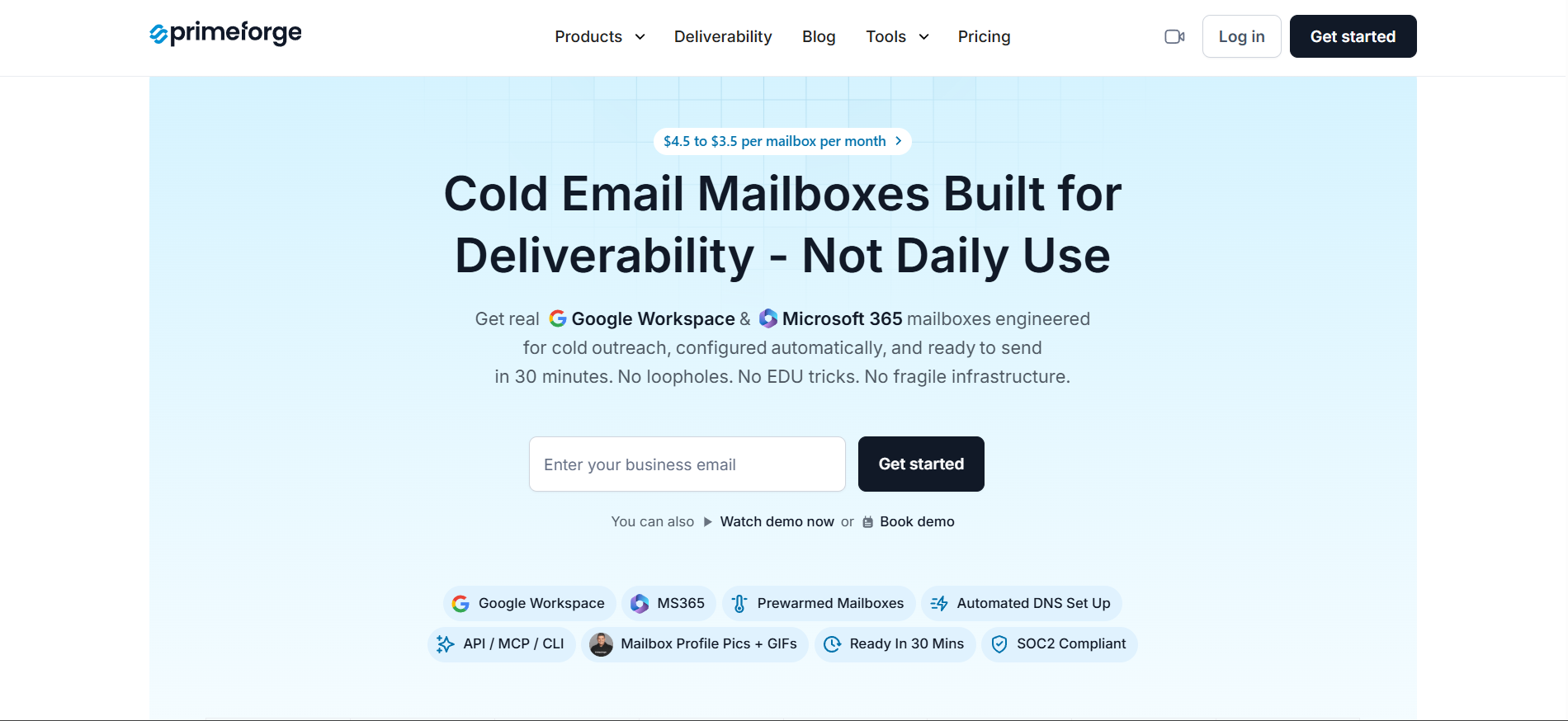
The pricing sits at $4.50 per mailbox per month on annual billing in 10-slot increments, which is higher than Mailforge or Maildoso but includes API access in the base subscription, unlike Zapmail which gates API to its $299 Pro plan.
Where Primeforge really pulls ahead of Cheapinboxes is bulk DNS automation. You can update SPF, DKIM, or DMARC across hundreds of domains in one action, which is the exact pain that shows up in Cheapinboxes complaints about DMARC records arriving broken.
And if your prospects use Google or Microsoft, sending from the same provider improves inbox placement through ESP matching, which no amount of shared-IP infrastructure can replicate.
The next Cheapinboxes alternative on my list is ScaledMail, and it sits at the opposite end of the spectrum from Mailforge.
Where Mailforge is self-serve infrastructure you set up in minutes, ScaledMail is a fully managed setup where you tell them the sending volume you need and they build the mailboxes, DNS, and IP rotation for you. Setup takes 24 to 72 hours instead of 5 minutes, and communication runs through a dedicated Slack channel with direct access to their technical team.
This is the right pick if you would rather hand infrastructure to an operator than run it yourself. What you trade for the white-glove treatment is speed and self-service control, plus a higher effective cost once you add reporting.
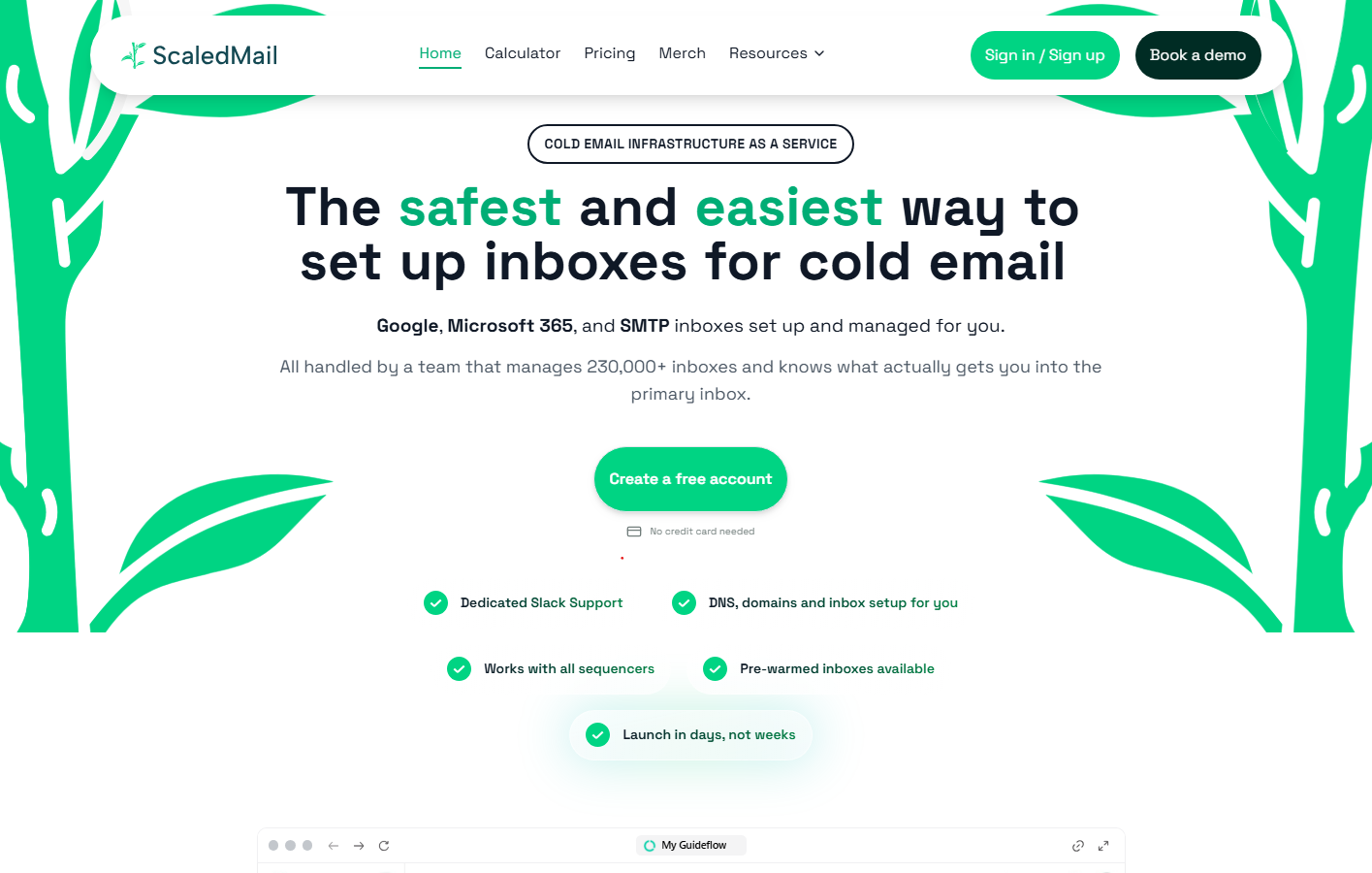
ScaledMail supports Google Workspace, Microsoft Outlook, and SMTP in one package, with pricing that runs $3.50 per mailbox for Google, $50 per domain for Microsoft, and $3.75 per domain for SMTP.
Reporting is a paid add-on rather than bundled in the base plan. For a 2,000-emails-per-day setup split across all three providers, the total lands around $653 per month including reporting.
If you want more managed-infrastructure providers in the same category, my ScaledMail alternatives roundup covers the field.
Another Cheapinboxes alternative that comes up often on cold email shortlists is Zapmail. It sits in the middle ground between Cheapinboxes' self-serve budget model and ScaledMail's managed setup.
Zapmail provisions real Google Workspace and Microsoft 365 mailboxes on US or EU IPs in roughly 10 minutes, and in-house warmup is baked in so you do not need a separate warmup subscription.
What you get in exchange for the convenience is bundle-based pricing, which is where it either works for you or it does not. The advertised $2.50-per-mailbox rate is a yearly billing floor, but the real entry point is $39 per month for 10 Google mailboxes on the Starter plan.

That means you commit to a bundle size before you know if the mailboxes will fit your workflow, which is worth thinking about if you are just testing.
The trust signals are unusually strong for this category. Zapmail reports over one million mailboxes provisioned, 330,000 domains managed, and a 4.5 Trustpilot rating, which puts it ahead of most competitors on public credibility.
For more Google and Microsoft mailbox alternatives in this bracket, my Zapmail alternatives roundup covers the field, and the Zapmail vs Maildoso comparison is worth a look if you are weighing the two head to head.
If you are picking a Cheapinboxes alternative purely on price, Maildoso is the one. At the 1,000-plus mailbox tier, SMTP mailboxes drop to $0.49 each, which is roughly one-sixth of what Cheapinboxes charges at equivalent volume.
The entry point is 30 mailboxes at $75 per month, so it is not a great fit for solo testers, but for agencies running high volume on tight budgets it is genuinely the cheapest option in this comparison.
The catch is that this is shared-IP SMTP infrastructure. If another sender on your shared IP triggers a blacklist, you feel it. Maildoso launched "self-healing mailboxes" in October 2025 that auto-pause burned inboxes for 14 days before reactivating them, which is a real operational improvement, but it manages the symptom rather than the underlying shared-infrastructure risk.
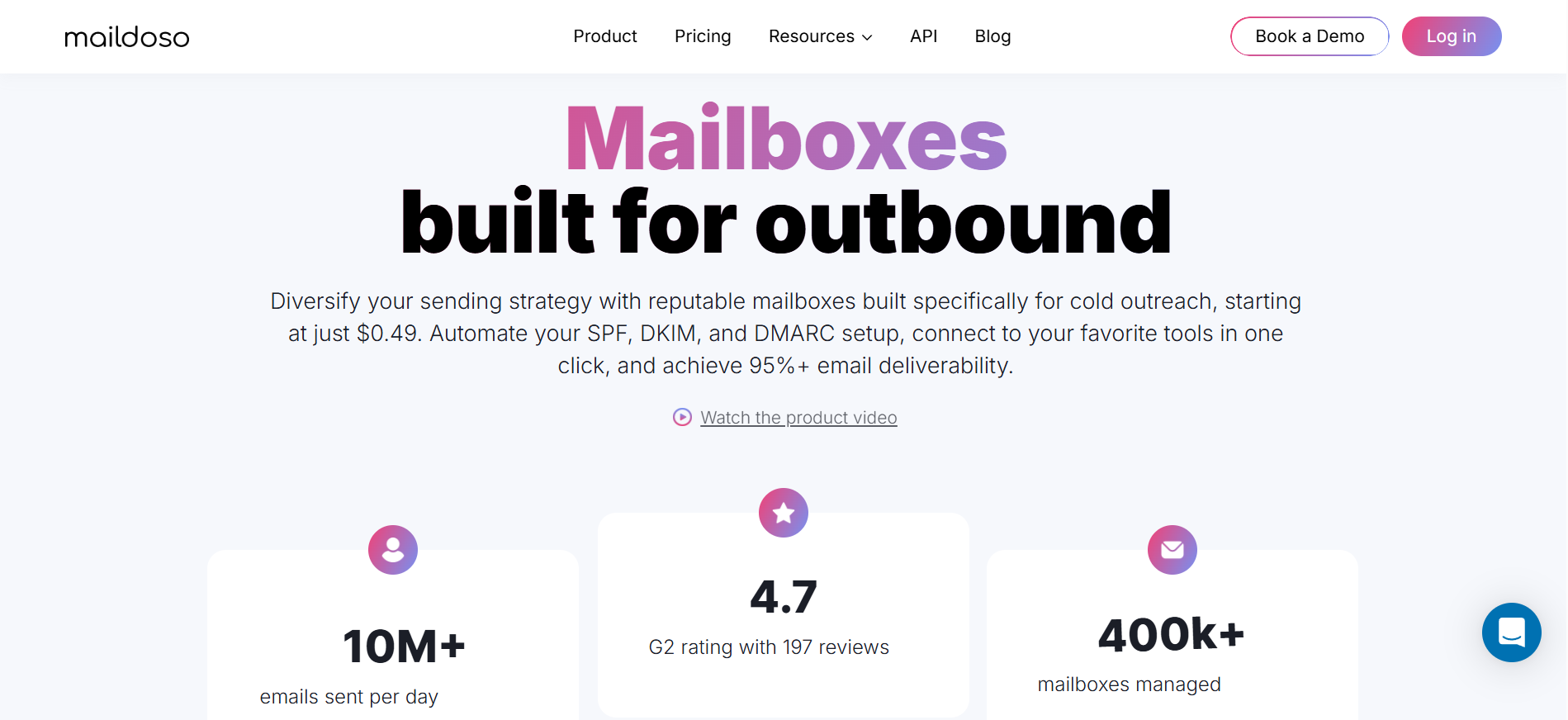
Maildoso ships SMTP mailboxes plus Google Workspace mailboxes as of December 2025, with automated DNS, warmup baked into sending ratios, and API access all included in the base subscription. If you are weighing Maildoso against similar alternatives, my Maildoso alternatives roundup covers where each pain point shows up in real use.
The last Cheapinboxes alternative on my list is Inboxlogy, and it is the one to look at if the bundle minimums on Zapmail or the 30-mailbox floor on Maildoso do not work for you.
Inboxlogy has no minimum order, which means you can buy one mailbox or a thousand at the same per-mailbox rate for your tier. That flexibility is genuinely rare in this category.
Inboxlogy provisions real Google Workspace and Microsoft 365 mailboxes with dedicated US and EU IPs, and pricing runs from $3.50 per mailbox at the 1-49 tier down to $2.80 at the 500-plus tier. Standard mailboxes ship cold with DNS configured.
If you need pre-warmed mailboxes, there is a separate flat-rate tier at $4.99 per mailbox that ships ready to send the same day.
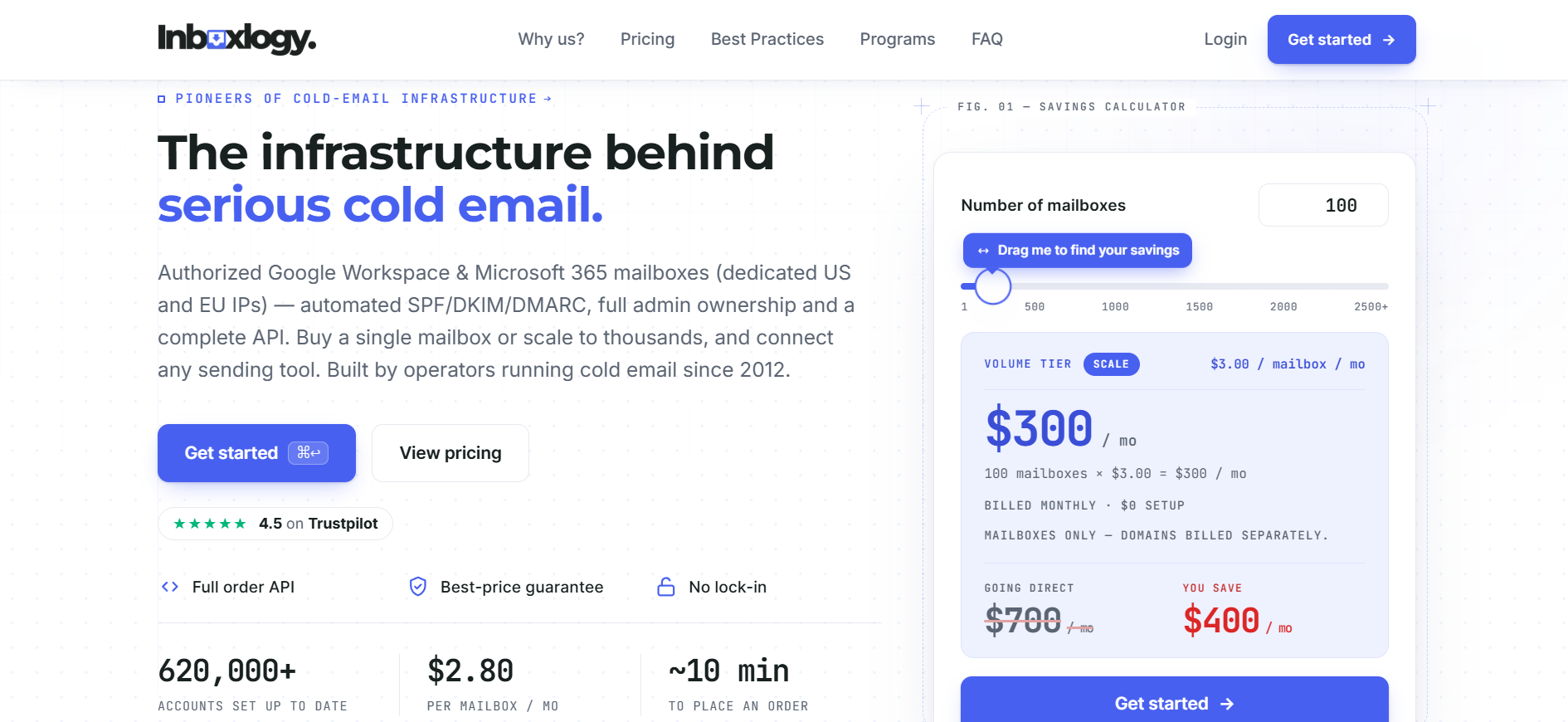
The tool markets full account ownership as a differentiator against providers that retain mailboxes or run them through marketplace models, which is a real advantage if you have been burned by a lock-in situation before.
The one thing to weigh is that Inboxlogy has a limited public review footprint compared to the more established alternatives in this list, which makes real-world performance harder to verify before committing.
The number one Cheapinboxes alternative on my list is Mailforge, and the reasoning is simple.
The two pain points that push most teams off Cheapinboxes are DNS reliability and the missing warmup. Cheapinboxes markets both as solved, but the reported reality does not match. Here is why Mailforge is the pick.
Start with Mailforge and get your infrastructure live in 5 minutes.
1. What is Cheapinboxes, and why are people looking for alternatives?
Cheapinboxes is a low-cost mailbox provider that sells Google Workspace and Microsoft accounts for cold outreach at $2.80 to $3.50 per mailbox. Teams look for alternatives because the pre-warmed marketing claim does not match reported reality, DNS records sometimes ship broken, and there is no bundled deliverability monitoring or public SOC 2 attestation.
2. Does Cheapinboxes actually include mailbox warmup, or do I need a separate tool?
Cheapinboxes markets mailboxes as pre-warmed at delivery, but multiple third-party reviews report you still need a separate warmup tool for ongoing volume ramp. If bundled warmup matters to you, Mailforge and Zapmail both include it in the base subscription, so you are not paying twice.
3. Which Cheapinboxes alternative supports Microsoft 365 mailboxes, not just Google Workspace?
Primeforge, Zapmail, Inboxlogy, and ScaledMail all support Microsoft 365. Mailforge is shared-IP infrastructure rather than real Microsoft accounts, and Maildoso does not currently support Microsoft (it is on the roadmap).
4. Which provider is cheapest once you are sending at real scale (500+ mailboxes), not just at the entry tier?
Maildoso wins on pure per-mailbox price at extreme volume, dropping to $0.49 per SMTP mailbox at the 1,000-plus tier. Inboxlogy is $2.80 at 500-plus mailboxes, Cheapinboxes is $3.00 at 250-plus, and Mailforge holds at $3 per mailbox on annual billing regardless of volume.
5. Do I need a dedicated IP for cold email mailboxes, or is shared IP infrastructure fine?
Shared IP infrastructure works if you send at moderate volume with clean lists and follow good sending hygiene. Dedicated IPs matter more when you are sending high volume, when you have been burned by shared-IP contagion before, or when you need full control over your sender reputation. Inboxlogy and Infraforge are the dedicated-IP options in this list.
6. How do I migrate off Cheapinboxes to another provider without losing my domains or breaking active campaigns?
You can transfer domains purchased through Cheapinboxes to any registrar after they are 60 days old using the auth code from your dashboard. Set up your new mailboxes on the alternative provider first, run them in parallel for a warmup period, then gradually shift campaigns over before canceling Cheapinboxes to avoid breaking active sends.
7. Which alternative has no minimum-bundle requirement if I only need a handful of mailboxes?
Inboxlogy has no minimum order and sells one mailbox at the same per-tier rate as a thousand. ScaledMail has no stated minimum either, though the smallest published bundle runs around $45 per month. Mailforge, Primeforge, and Zapmail all have 10-mailbox minimums, and Maildoso starts at 30 mailboxes.